
What makes a great conversational AI experience?

Key takeaways
- Great conversational AI design for voice is decided during the call, not in the script you wrote beforehand.
- Voice and chat are different design problems, and voice callers tolerate far less latency and imperfection than readers do.
- Five things separate a good voice conversation from a bad one: latency, turn-taking, interruption handling, prosody, and a resilient pipeline.
- You can't eyeball quality, so you test agents with simulated calls before they ever reach a customer.
- Vapi's stance is to build on a model-agnostic voice pipeline you can tune and evaluate, not a black box.
Introduction
A caller stops talking. For the next half second, nothing happens, and what the agent does with that pause shapes the whole call.
Most advice on conversational AI design was written for text, so it stops at persona and dialogue flow. On a live call they aren't enough, because a spoken conversation is a real-time systems problem.
A voice agent has to answer within a human beat, know when you're done talking, and handle you cutting in. It also has to sound like a person and keep going when a provider fails.
This piece walks through those five dimensions and the testing discipline that proves an agent works before a customer hears it. For the pipeline underneath, see how Vapi orchestrates the voice AI pipeline.
What conversational AI design really means
Conversational AI design is the discipline of shaping how a voice agent talks with people, so the exchange feels natural and resolves the task. Written guides define it well for text, covering intent recognition, persona, clarity, context retention, and graceful error handling. All of that carries over to a call.
The gap shows up in what those guides leave out. For voice, the words are only half the design. The other half is timing, how turns get handed off, and how the voice actually sounds.
A transcript can look perfect and still make a bad call. The caller heard a two-second delay, got cut off mid-sentence, or listened to a flat, robotic read.
Vapi treats an agent as a configured system you can change. It's a prompt, a transcriber, a model, a voice, and tons of configurables, such as interruption handling, that you tune to the use case. You make each of those a deliberate decision.
Getting the words right is table stakes. The rest of this piece is about the half of conversational AI design that only exists once someone speaks.
Voice and chat are different design problems
Chat and voice are distinct design problems. They diverge on tolerance.
A chat user will forgive a slow reply or a slightly awkward sentence. Reading is patient, and the words sit on screen until they're ready for them. A caller on a live line gives you none of that room.
On screen, a two-second pause reads as the system thinking. On a call, the same pause reads as a dropped connection or a bot that broke, and the caller starts talking again or hangs up.

On a live line, a pause the caller reads as a broken bot is enough to lose the call.
Voice also takes away the reader's escape hatches. You can't skim ahead, re-read a confusing line, or leave a message half-answered while you think.
The agent has to be right the first time, at the speed of speech.
There's no scrollback and no edit window. Design decisions that are minor in chat, like how long to wait before responding, become the difference between a natural call and a frustrating one.
Vapi's product exists for the interactions where that tolerance is lowest. These are the calls where empathy is required, and the stakes are too high for a chat widget. That's why it optimizes for the real-time path a caller actually experiences, rather than the text transcript you read afterward.
What makes a great voice conversation: five dimensions
Five dimensions decide whether a live voice conversation feels natural or falls apart. They're latency, turn-taking, interruption handling, prosody, and a resilient pipeline. Each one is a design decision with concrete thresholds.
Latency: answer within a human beat
People answer each other fast. Foundational cross-linguistic research (Stivers et al., 2009) puts the mean gap between conversational turns at about 200ms.
A 2024 analysis citing that work puts the English mean around 239ms. Nobody measures this consciously, but it sets the bar a caller expects from anyone on the other end of a line.
Miss that bar by enough and the call feels off. AssemblyAI's voice-agent architecture guide reports that delays beyond roughly 500 to 700ms start to feel unnatural. That's a narrow budget once you see where the time goes.
According to AssemblyAI, a naive sequential transcribe-think-speak pipeline can cost about 1.9 seconds. Well-optimized pipelines land around 600 to 900ms.
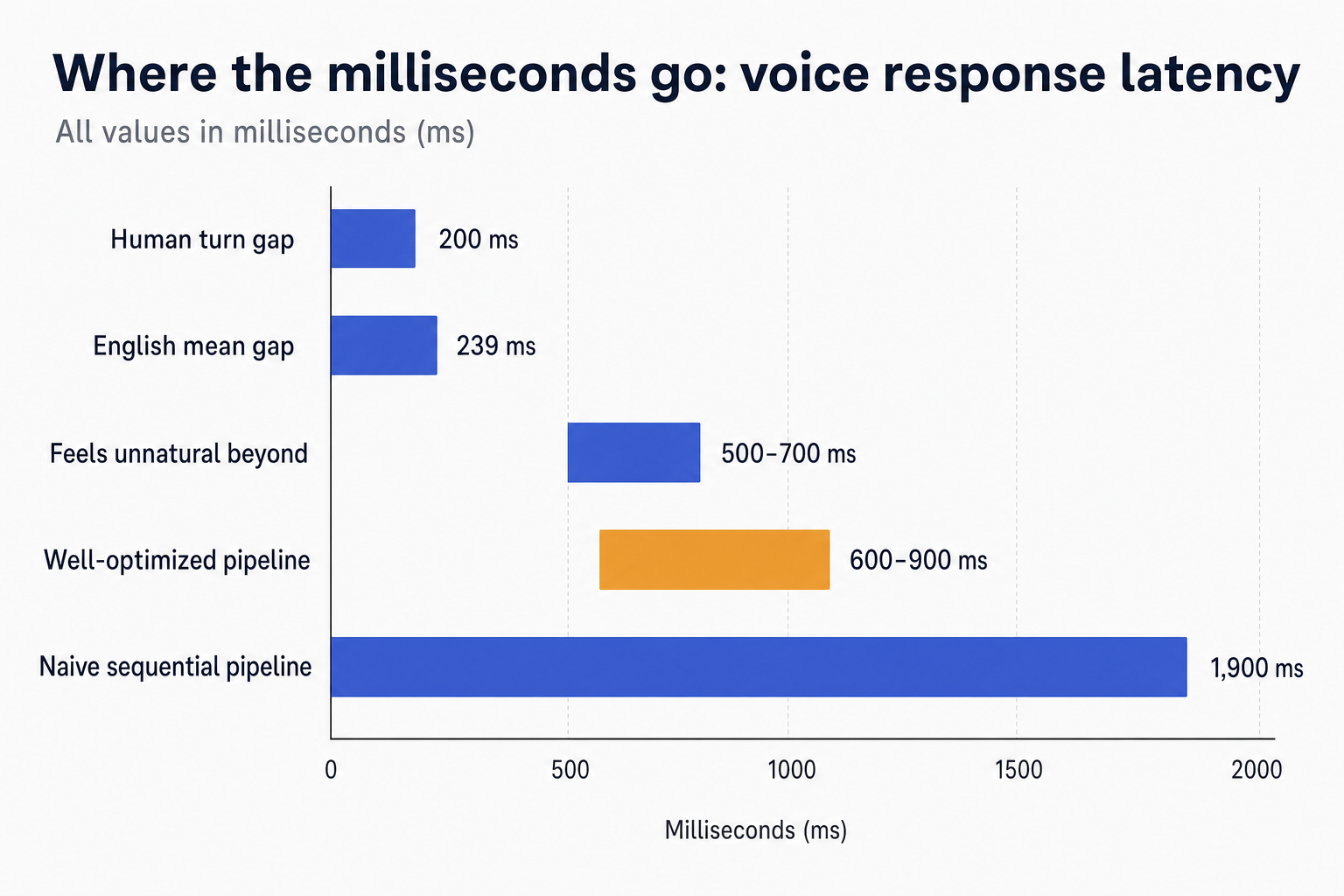
Every stage spends part of a tight budget. A naive pipeline blows past the human beat by nearly 10x.
The difference is architecture. It comes down to how the transcriber, model, and voice hand work to each other. How much of that work overlaps, instead of running in strict sequence, sets the total.
Every stage gets a latency budget, and you build to the budget rather than to an average. Vapi's approach is to treat the pipeline as a budget you can tune.
The transcriber, model, and voice are separate, swappable stages. You can see where the milliseconds go and change the stage that's costing you, instead of accepting a fixed black box.
Turn-taking and endpointing: knowing when to speak
The agent has to decide, in real time, when the caller is actually finished. That decision is endpointing, and it's the mechanic most conversational AI design guides skip entirely. Get it wrong and every other thing you built degrades.
Silence-based endpointers wait for a configured pause before treating a turn as done, commonly 500 to 800ms according to AssemblyAI. The threshold you pick is a direct tradeoff. Set it short and the agent jumps in mid-thought, set it long and the agent feels slow and hesitant.
Krisp and other voice-AI research describe this accuracy-latency tension plainly: no single pause length is right for every caller. Silence alone also misfires. People pause to think or search for a word, and a pure silence timer treats those hesitations as the end of a turn.
Semantic signals matter here: the agent needs a read of whether the thought itself sounds complete, on top of whether the audio went quiet.
Vapi's stance is that endpointing is a first-class, tunable setting you control directly. The platform exposes start-speaking and stop-speaking controls and interruption handling as configuration a builder can adjust, so you tune the pause to the use case. A slow medical intake and a fast quick-service order want different thresholds, and you set each one directly.
Interruptions: barge-in and picking up where you left off
Real callers interrupt. They cut in with a correction or an impatient "no, the other account" while the agent is still talking.
A good agent stops speaking immediately when that happens. Barge-in is an architecture-level requirement.
Recent research on structured, quick-service scenarios frames barge-in as something the system has to prioritize by design. The moment the caller speaks, the agent yields to their voice. It keeps recognizing input even while its own voice is still playing.
If the agent talks over the caller, the rest of the conversation is already lost.
Stopping is the easy half. The harder, less-discussed half is recovery. After the interruption is handled, the real test is whether the agent resumes the workflow at the right step, or loses its place.
Recent benchmark research treats post-interruption recovery as a distinct capability that many agents fail, separate from whether they can stop talking at all.
Vapi treats interruption handling as a configurable behavior you can shape. Builders control how the agent yields when a caller speaks over it and how it picks back up afterward. That keeps the hard part, resuming coherently, in your hands instead of buried in a vendor default you can't see or change.
Prosody: sounding like a person, not a narrator
A word-perfect answer still fails if the delivery is flat. Callers hear a monotone read and register a machine, even when every fact is correct. Prosody is part of the design.
Amazon Science, in foundational 2020 work, defines prosody as "the rhythm, emphasis, melody, duration, and loudness of speech." The same research notes that rendering everything with the same prosody "gets monotonous."
A confirmation number and a cheerful greeting shouldn't land with identical pacing and emphasis, because a person wouldn't say them that way.
Voice selection and delivery belong in conversational AI design from the start. The voice you choose, and how expressively it renders different moments, changes how competent and trustworthy the agent sounds.
Vapi's model-agnostic approach lets builders choose and swap the voice provider that fits the use case. No one synthetic voice gets locked in for everything.
A brand might need a warm, patient tone for support and a crisp one for outbound reminders. It can pick accordingly and change the choice later without rebuilding the agent.
A resilient, model-agnostic pipeline
A great experience also means the call doesn't fall apart when one provider has a bad minute. Model providers have outages and latency spikes, and those happen mid-call whether or not your design accounts for them.
The transcribe-think-speak pipeline is three separate stages: a transcriber, a model, and a voice, each typically from a different provider. When those stages are decoupled, you can swap any one of them and fall back automatically if it starts failing. The conversation stays alive because the agent routes around the stage that broke.
Lock-in to a single black-box stack is a reliability risk. If the whole pipeline comes from one vendor and that vendor goes down, your agent goes down with it. That happens mid-call, with a customer on the line.
Vapi's position is that serious voice AI runs on a model-agnostic pipeline. You can bring your own provider keys across speech-to-text, the LLM, and text-to-speech or use Vapi's. Either way, you should configure voice fallback so a provider outage routes to the next option instead of ending the call.
How to know it's good before a customer does: testing voice agents
You can't judge a voice agent by reading its prompt. Timing, turn-taking, and delivery only exist once the thing is speaking, so you have to hear it under real conditions before a customer does. Most teams skip this and ship on a hunch.
The numbers suggest the hunch is often wrong. According to Deepgram's 2025 State of Voice AI report, about 80% of surveyed organizations use some form of voice agent. Only 21% describe themselves as "very satisfied."
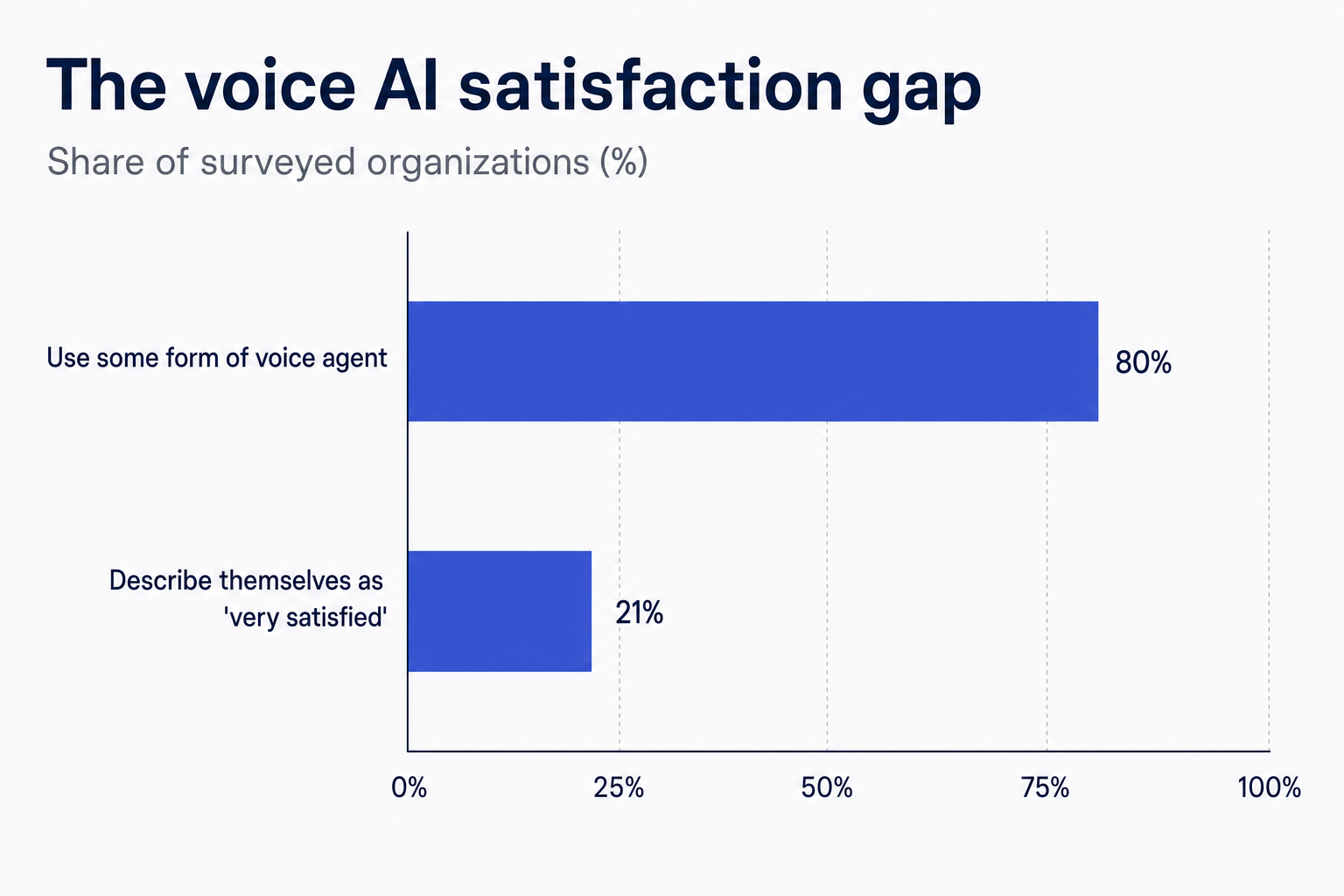
Adoption is nearly universal, but satisfaction is not. The gap is where testing earns its keep.
These are self-reported figures from surveyed organizations. Treat them as a market signal rather than a precise measurement.
Evaluation closes that gap. You simulate calls, score the transcripts against a rubric, and catch failure modes before any of it reaches production.
Those failures include wrong turn-taking, hallucinated answers, and bad recovery after an interruption. Then you keep doing it, because a model swap or a prompt change can regress behavior you already fixed.
Vapi builds testing into that loop. It runs simulated voice tests where an AI tester calls the agent, holds a conversation, and the transcript gets scored against a rubric you define. That turns "does this sound good" from a subjective listen into a repeatable check you run before every release.
This optimization loop is the main reason we see very different results from Vapi customers compared to what Deepgram reports above. Take Kavak, for example. They build new agent evaluations on Vapi in ~5 mins, continuously tuning the agent for tone, emotion, speed, and more. They evaluate effectiveness and then ship what works best to production. As a result, they've seen their NPS and conversion rates skyrocket (+20 and +30% respectively).
Getting started without writing code
You don't need to hand-build a pipeline to try any of this. Vapi's low-code dashboard and Composer, its natural-language agent builder, let you describe an agent in plain language and have it running quickly. From there you tune the timing and voice settings this piece covered, all without touching code.
The same agent is editable by a product manager in the dashboard and a developer through the API, working from one configuration. A support lead can ship a first pass and adjust endpointing, while an engineer goes deeper when the use case demands it. Sign up, describe the agent you want, and start tuning.
What's next
A great conversational AI experience is a real-time voice achievement, decided in the seconds of the call rather than in the script. The five dimensions plus disciplined testing give you a concrete checklist to build and measure against.
Start by putting a latency budget on each stage of your pipeline and simulating calls before you launch. Then build one, hear it, and tune it against real conditions.
Frequently asked questions
What is conversational AI design?
Conversational AI design is the discipline of shaping how a voice agent talks with people, so the interaction feels natural and resolves the task. For text, that means intent, persona, clarity, and error handling. For voice, it also means timing, turn-taking, and how the voice sounds, because those decide whether a live call feels like a real conversation or an interaction with a bot.
How is designing for voice different from chat?
They're different design problems that diverge on tolerance. A chat user forgives a slow or awkward reply because they can read at their own pace. A caller on a live line can't skim or wait, so a pause reads as a broken bot the agent can't afford.
Why does latency matter in a voice conversation?
Callers unconsciously expect a reply within a human beat, and foundational research (Stivers et al., 2009) puts the mean gap between turns near 200ms. AssemblyAI reports that delays beyond roughly 500 to 700ms start to feel unnatural. Past that window, callers think the connection dropped and talk over the agent or hang up.
How does a voice agent know when to start talking?
It uses endpointing to decide when you've finished a turn. Silence-based endpointers wait for a configured pause, commonly 500 to 800ms according to AssemblyAI. The threshold is a tradeoff: too short and the agent interrupts you, too long and it feels slow, and silence alone misfires on hesitations.
What makes an AI voice sound robotic?
Flat prosody. Amazon Science defines it as "the rhythm, emphasis, melody, duration, and loudness of speech," and warns that rendering everything the same way "gets monotonous." A correct answer in a single flat tone still sounds robotic, which is why voice selection and delivery are part of the design.