
One evening, Anna faced an issue. Her internet connection had been down for hours, and she hesitated to call customer support. She prepared herself for long wait times, robotic menu options, and the dreaded chance of being put on hold again just to “check the system.”
She made the call, and almost immediately, a friendly AI voice agent answered. It quickly verified her account, ran a quick diagnostic check, and said:
“There’s an outage in your area. The estimated fix time is 45 minutes. Would you like an SMS update?”
No transfers, no delays, just direct query resolution. A call that used to take 20 frustrating minutes was wrapped up in just 30 seconds.
“This isn’t just a fantasy of the future; it’s a reality we’re experiencing today. By 2027, it’s estimated that around 25% of customer service interactions will involve AI, a significant rise from just 2% in 2022 which accounts for $15-20 billion by 2027-2028, representing a compound annual growth rate (CAGR) of around 25-30%, according to Gartner.”
From long wait times and high operational costs to agent burnout and inconsistent service quality, traditional call centers have struggled to keep up with evolving customer expectations.
In this blog, we have covered some major pain points that traditional call centers generally face and how the adoption of AI call center solves them by utilizing the right AI tools.
When Anna contacted customer service, her initial hesitation represented some of the key pointers like long waiting times before address of the minor pain point which disrupts the brand image for the customer affecting the customer journey overall
The customer journey goes beyond just marketing, advertising campaigns, sales calls, and closing deals; a significant part relies on post-sale support. Higher the customer satisfaction, better the chances of retaining them for the long haul.
According to a Forbes article, 86% of end customers are willing to pay more for a better customer experience, and traditional call centers with tedious workflows often fail to cope with these expectations.
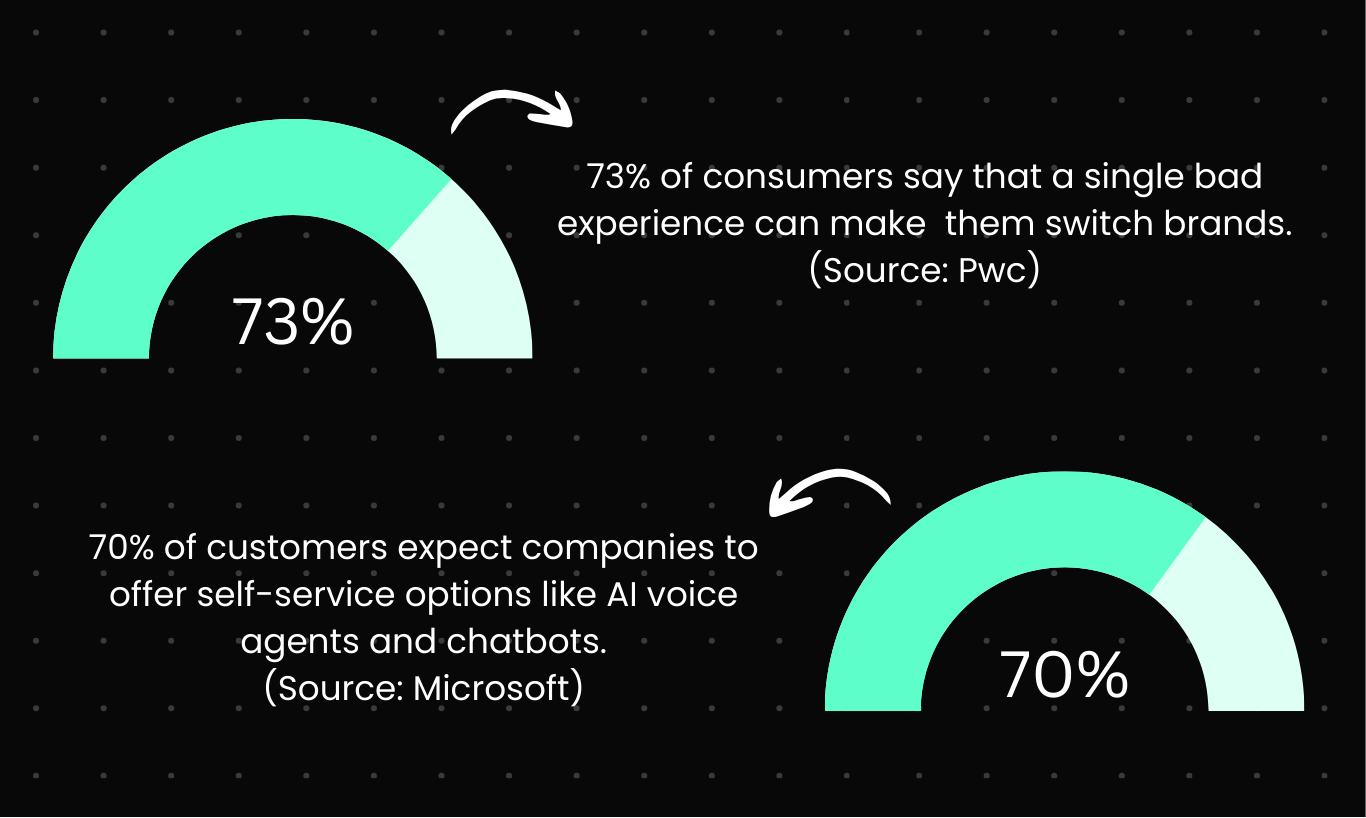
Customers today want quick solutions, but many traditional call centers struggle with limited staff and inflexible processes. When calls stack up, agents can feel overwhelmed, causing delays in handling customer inquiries efficiently. By the time a representative is available, the customer’s interest may have already waned, or the issue may have escalated.
For sales teams, this can mean losing out on prospective buyers; for support teams, it often leads to frustrated customers, resulting in losing customers to competitors.
Call center agents wear many hats, but answering calls is only one of their responsibilities. Managing call volumes, which often consist of monotonous customer queries such as shipping status, updating customer details for verification, or responding to ‘how do I' questions, frequently distracts customer support teams from the actual issues that require human intervention, such as billing disputes, troubleshooting for outages, or ethical dilemmas where company policy might conflict with a customer’s situation.
This places extreme pressure on human agents as they have to handle multiple frustrated customers who may have waited too long just to find out when their internet connection will be restored.
Holidays and promotions like Black Friday and Christmas are seen as growth opportunities, but they can become chaotic for many traditional call centers due to high call volumes, which causes challenges instead of successful conversions and revenue generation for the special offer and holiday seasons like these.
Longer wait times frustrate customers, while overworked agents face burnout and high turnover. Without automation, sudden call spikes overwhelm operations. According to Zendesk, during the holiday season, 60% of support teams report an increase in call volume, but only 29% of those indicate that they are scaling their operations workforce.
Afterward, businesses deal with negative reviews, trouble retaining agents, and lost revenue due to ineffective surge management.
Limited Call Response Hours
75% of customers expect instant service at any time. While it's clear that human agents cannot provide support around the clock, it's likely that some existing customers may be in different time zones or may face urgent issues outside of human agents' working hours.
After-hours inquiries account for about 35% of the total support volume, yet these customers are left with unresolved urgent issues and long wait times.
Addressing traditional call center challenges involves improving processes and technology for teams and customers. To reduce response times, companies could enhance workforce management and develop smart routing systems. A modern contact center integrates AI technologies to improve efficiency, reduce wait times, and enhance customer experience with real time sentiment analysis often behaving like humans.
Automation tools can alleviate agent workloads by handling repetitive tasks like checking order status, providing shipping information, or explaining basic product features, allowing agents to focus on major issues, billing disputes, or technical troubleshooting in case of outages. To meet scalability demands during peak seasons, hiring temporary staff or adopting cloud solutions is beneficial.
However, these improvements are limited, as they still depend on slow, costly human processes. AI call center agents overcome these limitations by automating and enhancing customer experiences and operational efficiency.
AI call centers are changing how we interact with customers by taking care of routine calls and analyzing customer service interactions on the spot. This allows for more personalized attention for each customer.
Picking the right AI solution is important. Vapi.ai is a standout choice, bringing a more innovative and more relatable approach to customer conversations and making AI-powered call centers feel more human.
Vapi.ai is a friendly AI voice assistant designed to be integrated as an assistant to the AI call center companies for better customer interactions within your existing workflows, as it integrates effortlessly with support systems to manage routine inquiries and intelligently route calls.
This allows human agents to focus on more complex customer queries, maintaining the advantage of having a voice assistant without entirely eliminating human intervention. Training customer service teams to utilize AI technologies effectively can further enhance these interactions.
Integrating Vapi.ai into your customer support isn’t just a quick fix; it is about how well businesses can utilize call center AI integration. Here are some key points to consider:
Think back to the last time you spoke with a customer. Remember how it felt when you truly connected with them, hearing their frustrations and realizing they had to repeat their questions multiple times while navigating through a frustrating maze of robotic menu options?
Now, imagine a different scenario where you already understand the issue your customer is facing. This insight allows you to respond with empathy and resolve their problem with ease, creating a more positive and meaningful experience for everyone involved.
This is precisely the vision the artificial intelligence call center brings along, with Vapi.ai at the forefront of assisting organisations like PolicyBind, Housecall Pro, and Hotel Planner. Rather than dealing with long waits, overwhelmed agents, and outdated processes, businesses can now embrace AI voice agents.
These tools handle routine inquiries, offer real-time insights, and let human agents concentrate on what really matters—their connection with the customer and providing exceptional service. Ultimately, AI-powered systems can deliver exceptional customer experiences by improving service quality and efficiency.
No, AI call center agents are here to complement human agents, not replace them. While AI voice assistants efficiently manage routine inquiries, they allow human agents the space to engage in more meaningful and complex interactions that require empathy, understanding, and nuanced problem-solving skills.
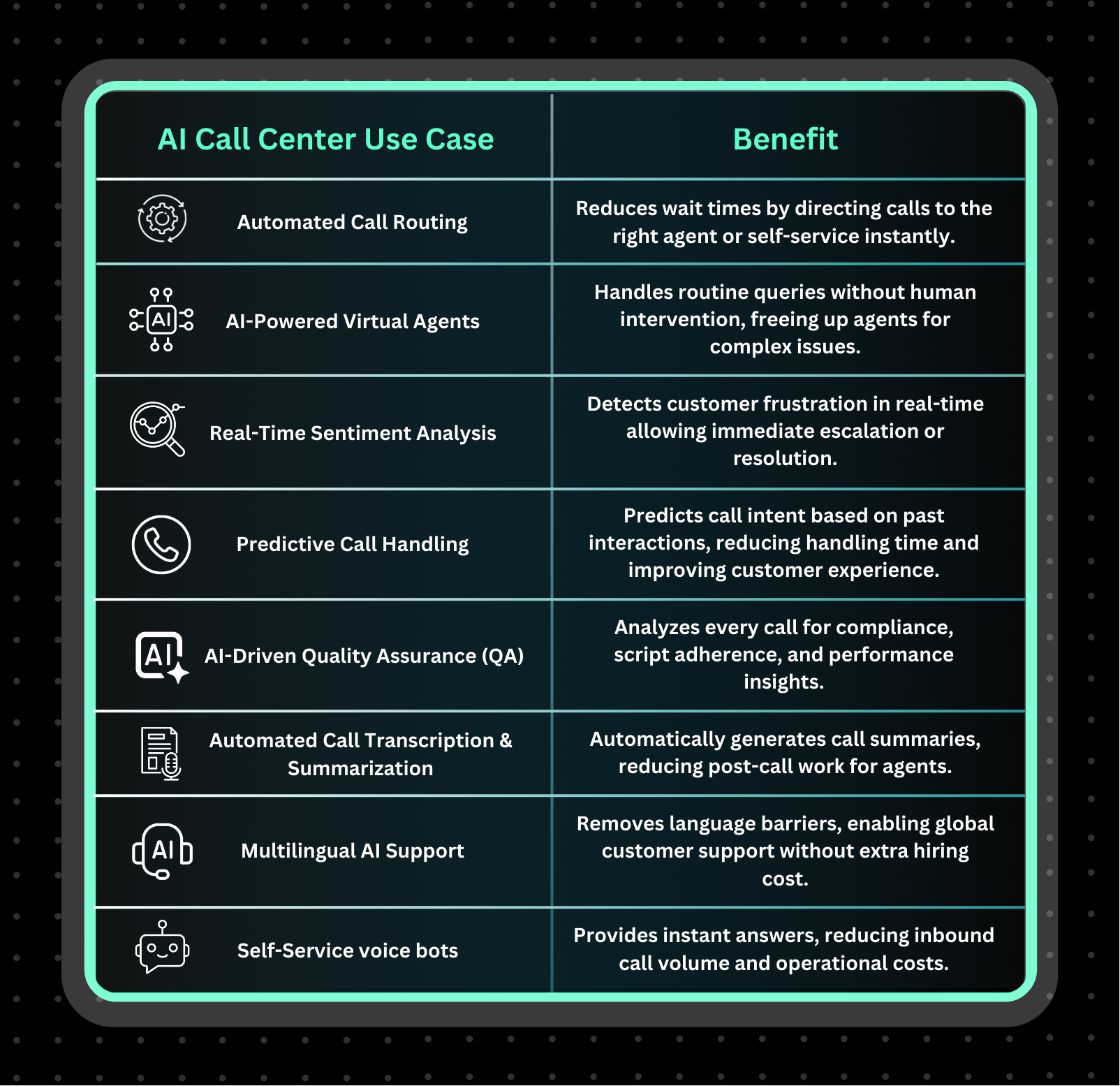
The call center AI solutions are widely utilized in the following ways:
The call center AI technology leverages natural language processing (NLP), machine learning, and real-time analytics to understand customer intent and provide instant responses. They integrate with CRM, ticketing systems, and customer databases to ensure seamless communication.
AI call centers integrate seamlessly with CRM platforms (Salesforce, HubSpot), ticketing systems (Zendesk, Freshdesk), and IVR solutions to ensure a unified workflow without disrupting existing processes.
Monitoring customer feedback is crucial for measuring the effectiveness of AI integration. Regularly analyzing feedback helps in guiding improvements and refining strategies to enhance customer service and satisfaction. This continuous loop of feedback ensures that the AI system evolves to meet customer needs better.


