Two weeks after the launch of the Humanness Index, the top models are landing within a few points of a real person.
The Humanness Index answers the one question the rest of voice AI benchmarking skips: does this sound like a person? You can already measure how fast a model starts talking and how accurately it reads a script. What nobody could measure at scale was whether the listener on the other end believed they were talking to a human. That belief decides whether a call works. It might be the most important question for any voice use case.
So we built a live, crowdsourced leaderboard. Two voice models use the same cloned voice to read the same line; you pick the one that sounds more human, and the votes are converted into a score that's measured against other models and even a real human recording. What we've seen so far is telling: the best models are now close enough to a real person that most listeners struggle to tell them apart. Over the first two weeks, xAI and MiniMax are leading that pack.
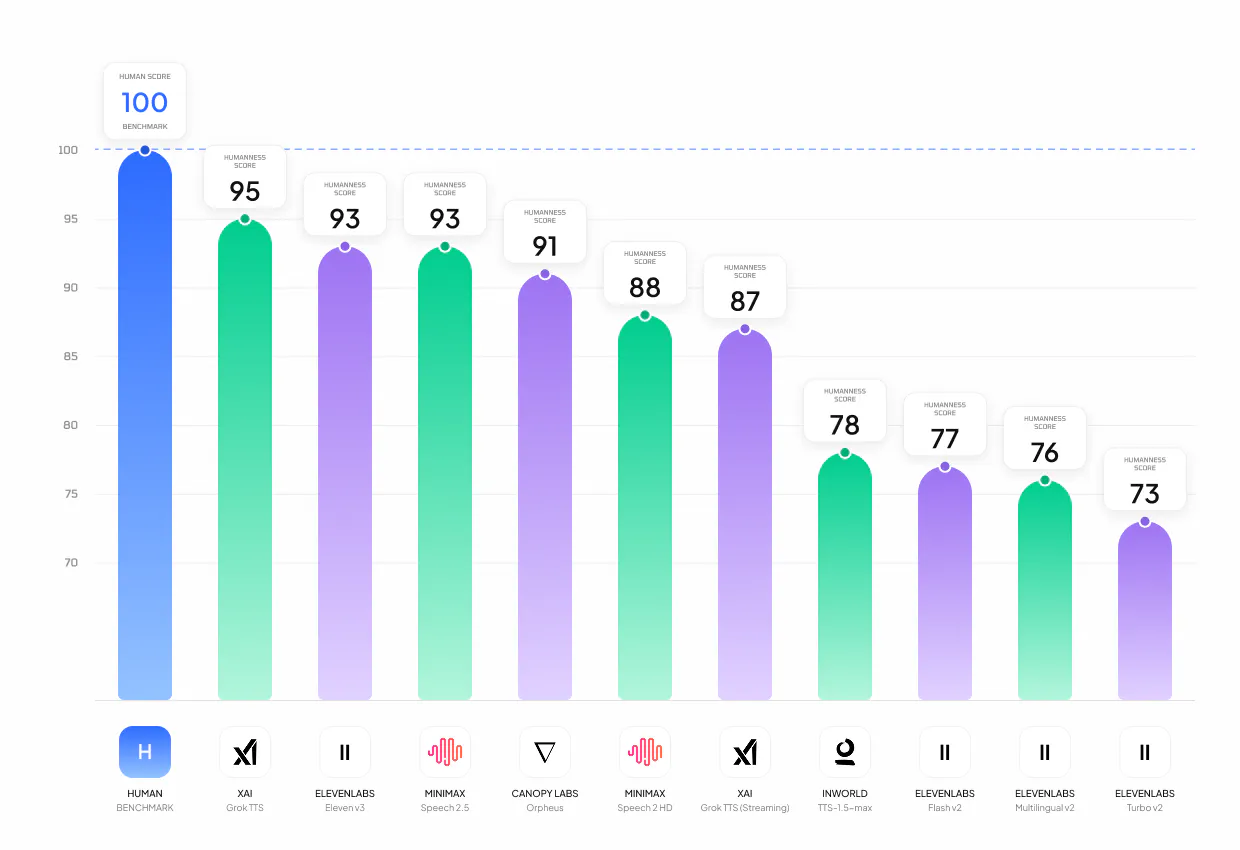
After almost a month and more than 11,000 votes, we have a strong first read on which models people believe sound the most human. The clearest takeaway is at the top of the board, where the leading models are landing only a few points under the real human reference. xAI's Grok TTS leads the models at 95, just five points under a real human. MiniMax Speech 2.5 sits right behind at 93. Both land within seven points of the human at 100 and show how the top voices are becoming nearly indistinguishable from the human voice.
Every battle is blind. Two voices read the same line, you pick the one that sounds more human, and the model names stay hidden until after you vote. We control the variables that make most voice evaluations traditionally hard to gauge. We took quotes and recordings from real people, cloned the same voice onto every model using each provider's cloning feature, and had every model read the same script, including filler words and trailing pauses.
The part that makes "near-human" a real claim is that the actual human recording is included in the comparison set, so when Grok TTS scores 95, it means listeners picked it over other models at nearly the same rate they picked the real human on the same quote in a blind test.
For years, the ceiling on voice automation wasn't just its intelligence; it was the voice itself. A model could reason through a messy, multi-step request, but the moment it spoke, a flat, monotone delivery gave it away, and the caller asked for a human. A score of 95 against a real person means the gap between a synthetic voice and a human is closing fast. Naturalness is no longer the bottleneck, and the caller actually experiences the agent's capabilities and reasoning rather than being distracted by the voice.
A voice agent with highly intelligent models can authenticate a caller, pull up an account, work through an exception, and explain the outcome in plain language, across thousands of calls at once. When the voice carrying all of that sounds human, the caller stays on the line long enough to get the resolution and have a genuinely good experience with a brand. That's the real potential the leaderboard points to: complex work handled at scale, without the stilted, dead-end feel people have learned to expect from voice automation.
The reasoning models keep getting better at understanding a request and working out what to do. But a caller never experiences the reasoning directly. They experience the voice, and it carries whether the interaction feels good and reaches a resolution. As the intelligence climbs, it matters just as much that the voice carrying it is closing in on human. The smartest agent still leaves a bad impression if it sounds like a machine. The leaderboard is early evidence that the voice is keeping pace with the intelligence behind it, and that's what makes a good experience possible.
When one deploys voice agents over the phone, in front of real people, in live conversations, it's humanness that decides the outcome. The Index draws on that, informed by a community of developers who build with voice every day and know what a real conversation should sound like, as well as the end users who experience it firsthand.
These scores only mean something because people are voting, and in two weeks you've already cast more than 11,000 votes. That's what got the top of the board this tight. Here's why your vote matters: the more people who vote, the stronger the signal we have about which models sound closest to human, which can be used to create even more accurate scoring. The top four models are separated by a single point each, all sitting within single digits of a real human. Every comparison you submit sharpens the gaps between models that are currently too close to separate. The more diverse the people listening, technical and non-technical, the better the Index reflects how real listeners hear these voices.
It takes about a minute, and your ears are the instrument. Listen to a few battles and tell us which voice sounds more human at humannessindex.vapi.ai. Then check back, because the rankings move as the field does.