You can reduce customer wait times with AI in two distinct ways, and most advice only covers one.
The average customer abandons a call at 2 minutes 36 seconds, according to SQM Group. Before that point, patience holds steadier than most teams assume.
SQM Group also found that CSAT doesn't move for waits between 1 and 120 seconds. It drops only once the wait passes 2 minutes. The damage arrives as a cliff at that mark. That changes what you optimize for. A dashboard obsessing over five-second improvements inside the safe zone is chasing a number that customers don't feel.
ContactBabel's UK Contact Centre Decision-Makers' Guide 2024 put the mean UK call abandonment rate at 8.4% in 2024, near the highest range in two decades. In the same guide, mean average speed to answer hit 1 minute 56 seconds, just under that two-minute cliff.
The stakes climb past that point. Zendesk's CX Trends 2025 report found 63% of customers would switch to a competitor after one bad experience, up 9 points year over year. Qualtrics estimates nearly $3 trillion in global sales are at risk in 2026 from bad customer experiences. So the goal worth chasing is fewer reasons to wait in the first place.
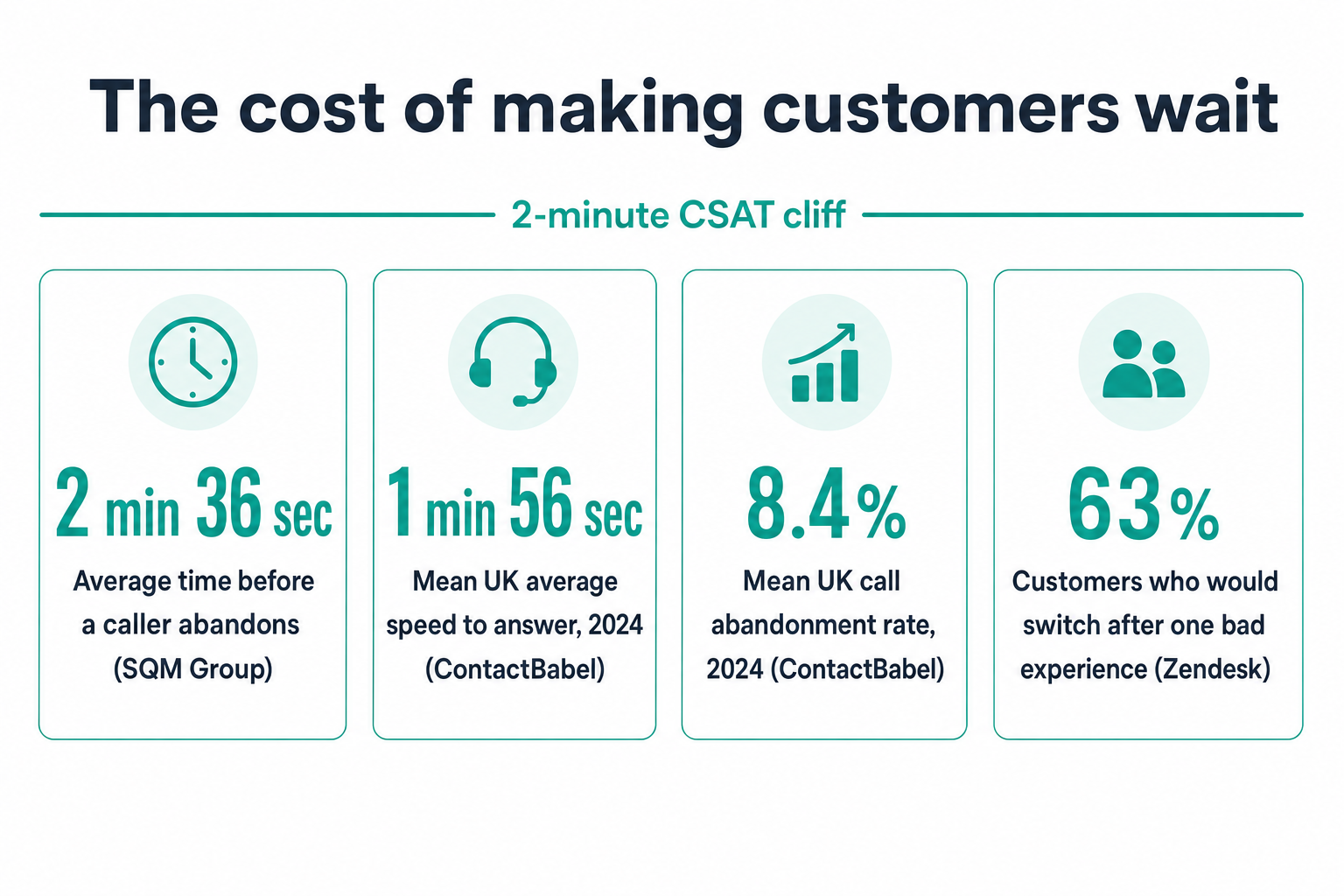
Patience holds steady until the two-minute mark, then satisfaction falls off a cliff
Most wait-time advice treats waiting as one thing, but a voice agent splits it into two.
Queue wait is the time before anyone or anything responds. It's hold music and ring time, the minutes before a human picks up. This is the wait every contact center already measures, and it's what average speed to answer captures.

Customers rarely call from a quiet desk. Every second of hold or lag competes with whatever else they're doing.
In-conversation latency is different. It's the lag between the caller finishing a sentence and the agent replying. Chat widgets mostly dodge this because typing hides the gap. A person waits a few seconds for a reply bubble and thinks nothing of it. Voice can't hide it, because silence on a phone line reads as a problem.
Most "AI reduces wait times" advice only addresses the queue. A voice agent forces you to solve both, because a caller hears every pause. Vapi runs on real phone calls where both waits are audible.
The rest of this piece follows that order: mechanisms for the queue first, then responsiveness, then reliability.
Four mechanisms shrink the queue by taking work out of it, and each one is proven in production. Judge them by resolution as much as speed.
Deflection, routing, agent assist, and demand prediction each pull work off the line before it stacks up.
A voice agent answers routine questions 24/7 with no hold. Every routine call it resolves is a contact that never enters the queue behind a human. That's deflection. It compounds at volume.
Freshworks reported that AI agents deflected 45%+ of incoming queries across its customer base, exceeding 50% in retail at 53%. Freshworks also reported a case study where first response time dropped from 12 minutes to 12 seconds. Treat those as Freshworks customer data, not an audited industry average, and expect your own numbers to depend on your call mix.
An agent that "contains" a call and then dumps it on a human hasn't deflected anything. It just moved the wait one step down the line. Measure resolution rate and containment rate as separate numbers in your reporting, so a rising containment number can't hide a stalled resolution number.
When a call does need a person, routing decides how fast it lands on the right one. Skills-based routing and real-time availability match the caller to the resource that can actually solve their problem. A billing question shouldn't bounce through two wrong desks before it reaches someone who can pull the invoice.
The mechanism is straightforward. The agent captures intent in natural language at the start of the call, then hands off with that context attached. The human who picks up already knows why the customer called and what's been tried. Fewer transfers and less repeating means faster resolution.
I won't quote a fixed percentage for routing's wait-time reduction, because no independent source supports one. The gain shows up in first-call resolution, where fewer wrong-desk transfers mean more issues closed on the first try. A misrouted call is a hidden wait, since the clock keeps running while the caller gets passed around.
AI doesn't have to take the whole call to cut wait times. It can sit beside a human agent, draft replies, and pull account context while the call is live.
The NBER study by Brynjolfsson, Li, and Raymond studied about 5,000 support agents at a large software firm. Generative-AI assistance raised hourly inquiry throughput by 13.8%. The least-experienced agents gained the most, about 35%.
That pattern matters for staffing. AI lifts the floor more than the ceiling, so your least-experienced agents get the biggest boost and the whole team clears the queue faster. It reads like a codified version of what your best agents already know, handed to everyone on the floor mid-call. The practical effect on wait times is a workforce that resolves more calls per hour without adding headcount.
Forecasting call volume and staffing to match it keeps the queue from building during predictable peaks. The wait you prevent never has to be cleared.
A propensity-matched study of 12,342 patients at Shanghai Children's Medical Center, published by Li and colleagues, shows how far this can go. Outpatients could auto-order labs before seeing a doctor. Median wait fell from 1.97 hours to 0.38 hours, about 80%. The gain came from moving work upstream, so the test was already running before the visit began.
This is a clinical setting. The size of the reduction won't transfer exactly to a phone queue. But. the principle does carry over: predict demand and prepare for it, so people don't stack up waiting. On a phone line, that looks like forecasting your Monday-morning spike and having agents, human or AI, ready before the calls land.
Answering on the first ring is wasted if the agent takes a beat too long to reply, and callers hear that beat. This is where queue-focused advice runs out.
Human conversation sets the bar: Stivers and colleagues, writing in PNAS, found that turn-taking gaps peak at 0 to 200 milliseconds across 10 languages. People start preparing a response before the speaker even finishes. AI needs to do that, too.
The network adds delay of its own. ITU-T Recommendation G.114 puts one-way transmission delay under 150 ms in the natural range. From 150 to 400 ms the delay is noticeably impaired, and above 400 ms it's generally unacceptable. That's transit alone, before any processing.
A voice agent stacks work on top of that budget. It transcribes speech, runs a language model, then synthesizes a voice, one stage after another. The whole response window has to be engineered toward the roughly 300 ms mark where conversation feels natural.
Industry guidance from AssemblyAI puts numbers on the feel. Around 300 ms sounds natural. By 500 ms the reply starts to feel slow, and longer than that callers assume they weren't heard and start talking again. When they talk over the agent, you get crosstalk and a restart that stretches the call. So the lag adds handle time to the very calls you sped up at the front.
Three levers keep the window tight:
This is why Vapi exposes voice pipeline and speech configuration, including endpointing and interruption handling, as first-class settings rather than buried defaults.
Agents that fall over at peak volume erase the wait-time gains you just made. Reliability belongs in the wait-time plan.
When one transcription, language, or voice model in a single-vendor stack goes down, every call routed through it goes down too. The queue you worked to eliminate comes back during the exact peak that triggered the outage.
A model-agnostic approach changes the failure mode. If one provider degrades, the system falls back to the next-best transcriber, model, or voice, and the call keeps moving. Vapi supports transcriber and voice fallback configuration, plus bring-your-own models across STT, LLM, and TTS. That's the same flexibility that lets you pick the best model for each job, applied to keeping calls alive when one option falters.
A provider that's up but slow is still a wait. Automatic failover to a faster option keeps the response window inside the budget from the last section. Build this into your wait-time plan before you scale to peak volume.
You don't need a year-long program to start. Pick a narrow slice and ship it, then expand from proof.
Step 1: choose your highest-volume, most predictable call type. Order status and appointment booking are good first targets because the intent is clear and the resolution is bounded. Starting narrow also gives you a clean before-and-after read on wait times for that one call type.
Step 2: add more intents and connect the agent to your systems. Tool calling lets it read and write to your CRM or ticketing system, so it resolves the request instead of just answering questions about it. An agent that can update an order or book the slot finishes the request on the call.
Step 3: tune the handoff. Decide which complex cases go to a human, and make sure the agent passes full context so the caller never repeats themselves. A clean handoff is where the queue-wait and in-conversation-latency work meet the human side of the operation.
You don't have to write code to begin. Sign up, build a first agent in the dashboard's low-code Composer builder, and Vapi automatically connects it to a phone number for inbound or outbound calls. From there, you tune the voice pipeline settings that keep replies inside the conversational window.
Instrument the funnel before you launch, so you have a baseline to compare against. Five metrics tell you whether wait times actually dropped:
The false win to watch for is deflection that quietly routes work to a human inbox later. It reads as containment while the wait just moves downstream.
How does voice AI reduce customer wait times?
Two ways. It removes work from the queue through self-service deflection, intelligent routing, agent assist, and demand prediction. It also answers instantly with no hold time, so callers never wait.
How much can voice AI realistically reduce wait times?
It depends on your call mix, so be skeptical of fixed figures like "60% faster." Freshworks reported 45%+ query deflection across its customers, and in healthcare one peer-reviewed study cut median outpatient wait about 80%. Your results track how many calls are routine enough to fully resolve.
Will AI voice agents replace human agents?
Human agents still own the calls that need judgment or empathy. The stronger pattern is AI handling routine volume while people take the rest. The NBER study found AI assistance helped the least-experienced agents most, raising their throughput 35%.
Why does a voice AI agent sometimes feel slow even when it answers instantly?
Because instant pickup and a fast reply are different problems. Humans expect a conversational gap near 300 ms, per AssemblyAI's guidance. If the transcription, model, and voice stages together push the reply past 500 ms, the caller feels the lag. That happens even with zero hold time.
What happens if a voice AI provider goes down mid-call?
On a single-vendor stack, the call can fail. A model-agnostic setup falls back to the next-best transcriber, model, or voice, so the conversation continues. Vapi supports that fallback configuration across STT, LLM, and TTS.
What should I measure to prove wait times went down?
Baseline first, then track average speed to answer, abandonment rate, average handle time, and first-call resolution. Track the deflection that actually ends in resolution, since raw containment can hide deferred work. Tie the improvement to retention and repeat-contact rates to confirm it's real.