
Best AI voice agents for CX: how to evaluate them for customer experience

Key takeaways
- Judge the best AI voice agents for CX by resolution and experience.
- Seven criteria separate a production agent from a prototype, spanning resolution, voice quality, action-taking, escalation, model flexibility, lifecycle trust, and platform control.
- Voice is its own real-time problem, and live callers tolerate far less latency and imperfection than chat users.
- The market splits into CX platforms, CCaaS-native tools, and developer-first platforms, so fit depends on how much control and ownership you need.
- Vapi sits as a platform layer teams own, model-agnostic, with resolution and lifecycle control built in.
The best AI voice agents for CX resolve problems, not just deflect them
The best AI voice agents for customer service earn their keep on hard calls. American consumers now reach for the phone on exactly those interactions. Research from ContactBabel found that phone preference for complex interactions rose from 28% in 2018 to 47% in 2024.
Those are the urgent, high-stakes moments where scripted automation has historically failed people. The best AI voice agents for CX have to win right there.

When the problem is complex, customers still reach for the phone.
Most "best voice agent" lists rank vendors on how a demo sounds. CX leaders live with the 10,000th call, at 2 a.m., when a customer is angry, and the account data is messy.
That gap between a clean demo and a real call is where this rubric focuses. It sorts production-grade CX agents from prototypes that only sound good on stage.
"Containment" and "deflection" count any call kept away from a human, and a contained caller may have simply given up and hung up.
Resolution counts a problem actually solved. Vapi's stance is direct: voice agents should resolve calls. Success shows up in CSAT, NPS, and resolution.
This guide gives you a seven-part rubric for evaluating AI voice agents for CX. It is vendor-neutral by design, and it states where Vapi stands on each debated question.
What an AI voice agent for CX is, and why voice is its own problem
An AI voice agent is software that holds a real, spoken conversation. It understands intent, takes action in your systems, and either resolves the issue or escalates it. That happens over a phone line or embedded in your product.
This isn't an IVR with better speech. An IVR walks a caller down a rigid menu tree and breaks the moment someone goes off-script. A voice agent listens, adapts, and responds in natural language, so the caller gets a real answer.
Voice and chat are distinct design problems. Where they overlap, the dividing line is tolerance. A chat user forgives a slow or slightly awkward reply, while a live caller doesn't.
Silence on a call reads as a dropped connection, so latency governs whether the conversation feels human. Across languages, the gaps between speakers cluster around 0 to 200 milliseconds, with medians that vary by language, according to Stivers and colleagues in PNAS.
That range is the window a voice agent gets measured against. Modern voice agents run a cascaded pipeline: speech-to-text, then a language model, then text-to-speech, orchestrated in real time.
Each stage adds delay, so a real-time agent has to trim time everywhere at once. It also has to recover gracefully when a caller interrupts, coughs, or trails off mid-sentence.
Vapi is built around that cascaded transcriber, model, and voice path. Configurable endpointing and interruption handling let teams tune how the agent listens and when it speaks.
How to evaluate AI voice agents for CX
Use these seven criteria in sequence. Each one pairs something to check with a question to ask any vendor. That way you compare tools on your own call mix.
Score each criterion on your own recordings. Pull 50 to 100 real calls that reflect your actual mix of intents, accents, and account states. Run the same set past every vendor so the comparison stays honest.
1. Resolution, not just containment
Containment counts calls kept away from a human, and it includes callers who abandoned or gave up. Resolution counts problems actually solved on the call.
First-call resolution and satisfaction move together: SQM Group reports that "for every 1% improvement in FCR, there is a 1% improvement in customer satisfaction". Industry-average FCR sits around 70%, and world-class is 80% or higher.
Vapi optimizes for resolution and exposes call-level logs. Your team sees what actually happened. Amazon Ring moved its inbound support to Vapi and saw CSAT rise.
Question to ask a vendor: how do you measure resolution, and will you show it on a sample of our real calls?
2. Real-time voice quality
Voice quality is a CX outcome. Check latency, natural turn-taking, interruption handling, and tolerance for background noise. Measure median latency under real load with concurrent calls.
An agent that talks over customers or freezes when a toddler cries in the background loses trust fast.
On purpose, test the ugly cases: call from a moving car, talk over the agent, then go silent to see how it recovers. A demo on a quiet line tells you almost nothing about a Monday morning queue.

Real calls come from moving cars and noisy rooms, not quiet demo lines.
Vapi treats real-time quality as configurable, with settings for endpointing, interruption handling, and background denoising. It has published engineering work on latency and filtering out background speech.
Question to ask a vendor: what is your median latency across a batch of concurrent live calls, and how do you handle interruptions?
3. Action-taking in your systems
Answering questions is table stakes. Resolving a problem means doing something: looking up an order, verifying identity, processing a change, or booking an appointment. That requires reliable function calling into your systems and predictable behavior when a call fails.
Ask for a live test of tool reliability and failure modes.
Vapi's agents take action through tool calling and native integrations across CRMs, databases, and business tools. The agent completes the task.
Question to ask a vendor: can we test function-calling reliability on our own APIs, including how the agent behaves when a call times out?
4. Escalation with full context
Your first agents won't be able to handle every type of call. The handoff is where CX is won or lost. When the agent escalates, the transfer should carry the full transcript, the detected intent, the steps already tried, the caller's sentiment, and their authentication state. A warm transfer routes into your existing human queue with all of that attached.
Vapi's agents overlay your existing telephony and warm-transfer into your ACD with context.
Question to ask a vendor: exactly what data transfers to the human agent at escalation, and does it land in our existing queue?
5. Model flexibility and reliability
Speech-to-text, language, and voice models shift constantly, so lock-in to any single provider is a liability. Look for the ability to swap providers as quality changes and to fail over automatically if one goes down mid-call.
Buying keys through the platform and bringing your own are both valid, and platform-purchased keys can cost less through volume pricing. Choose based on your procurement and data needs.
Vapi is model-agnostic by design, so you can swap any speech-to-text, language, or voice provider and configure automatic fallback when one fails.
Question to ask a vendor: which providers can we swap, and what happens to a live call if our chosen model provider goes down?
6. Lifecycle trust: testing, observability, and improvement
A launch score tells you little about the agent's month-12 performance, which is what you are really buying. Look for simulated voice testing before production, monitoring with call-level logs, and evals that catch regressions and drift.
Without those, you find out about a broken agent from an angry customer instead of a dashboard.
Ask to see the vendor's own change log. A team that ships improvements weekly will show you a busy history, and a stalled product won't. That cadence predicts how fast your agent gets better after you sign.
Vapi builds lifecycle tooling in, with simulated voice testing, monitoring and logs, and evals to catch problems before customers do.
Question to ask a vendor: how do we test an agent before it ships, and how will we know when its quality drifts after launch?
7. Platform control vs. black box
The last question is how much you can inspect, override, and tune. A closed vendor stack asks you to trust its models, data, and roadmap. A platform layer lets you see call-level behavior, change prompts and providers, and govern what agents do.
Transparency and governance matter more as the stakes of a call rise.
Vapi's strategic position is explicit here: a platform layer with transparency, flexibility, and governance built for voice, not a black box.
Question to ask a vendor: what can we see and change ourselves, and what stays locked inside your stack?
The four categories of AI voice agents for CX
Before you compare features, place the vendor. Three questions do it: who owns the logic, who owns the data, and who picks the model. Ask "who owns" rather than "can I configure," because every vendor claims configurability and only some will hand over the decision. If the vendor owns all three, you're renting an outcome, not owning one. And rented outcomes don't compound.
Horizontal agent apps sell a packaged agent for a business function like support or scheduling. You shape it through their proprietary studio, or you hand configuration to their engineering team and they shape it for you. Live quickly, and the ceiling arrives with it. You don't pick the model, so when model costs drop, the savings land in their margin, not yours. And your agent behaves like every other deployment of theirs, because that's the product.
Vertical point solutions go narrower: one workflow, one industry, pre-built and tuned. Patient intake, claims triage, dealership service scheduling. They work well inside the lines and stop at them. The economics are worth reading closely, because your call data usually trains their dataset, and that dataset gets sold to the companies you compete with. It isn't hidden. It's the pitch.
CCaaS-native add-ons bolt an agent onto the contact center suite you already run. Convenient if you live in that stack, and the incentives are worth thinking about before you commit: a vendor whose revenue comes from agent seats has a structural reason not to reduce agent seats. Their roadmap sets your pace.
Open platforms give you the prompts, the logic, the models, the evals, and the data, and run the infrastructure underneath. Model rate changes hit your margins. Concurrency, telephony, latency, and failover stay someone else's problem. The honest trade is that you need to have a builder's mindset for that first agent. What usually happens after that is the part people miss: Kavak started with a small platform team and now has around 250 internal builders, including ops staff and mechanics, because once the first agent is running, the people who know the customer journeys are the ones who improve it.
Vapi sits firmly in the open platform category: own your workflow and models, deploy fast, and keep control as you scale. Straightforward enough for an operator to start in the dashboard and deep enough for engineers to configure through the API and SDKs.
Vapi reports 1 billion+ calls, 1 million+ developers, and 2.7 million+ agents on the platform. Amazon Ring evaluated 40+ voice AI vendors before choosing it.
To place a specific vendor, ask who owns the logic, the data, and the model choice. If the vendor owns all three, you're renting an outcome. Owning them yourself buys leverage that compounds as your use cases grow.
Build, buy, or platform comes down to how much voice matters to you. Renting a packaged agent is fine while voice is a cost line to contain. Ownership starts to matter once voice touches your product or your P&L.
Grand View Research valued the AI voice agents market at $2.54 billion in 2025 and projects $35.24 billion by 2033, a 39.0% CAGR. Estimates vary by firm, though the direction is consistent.
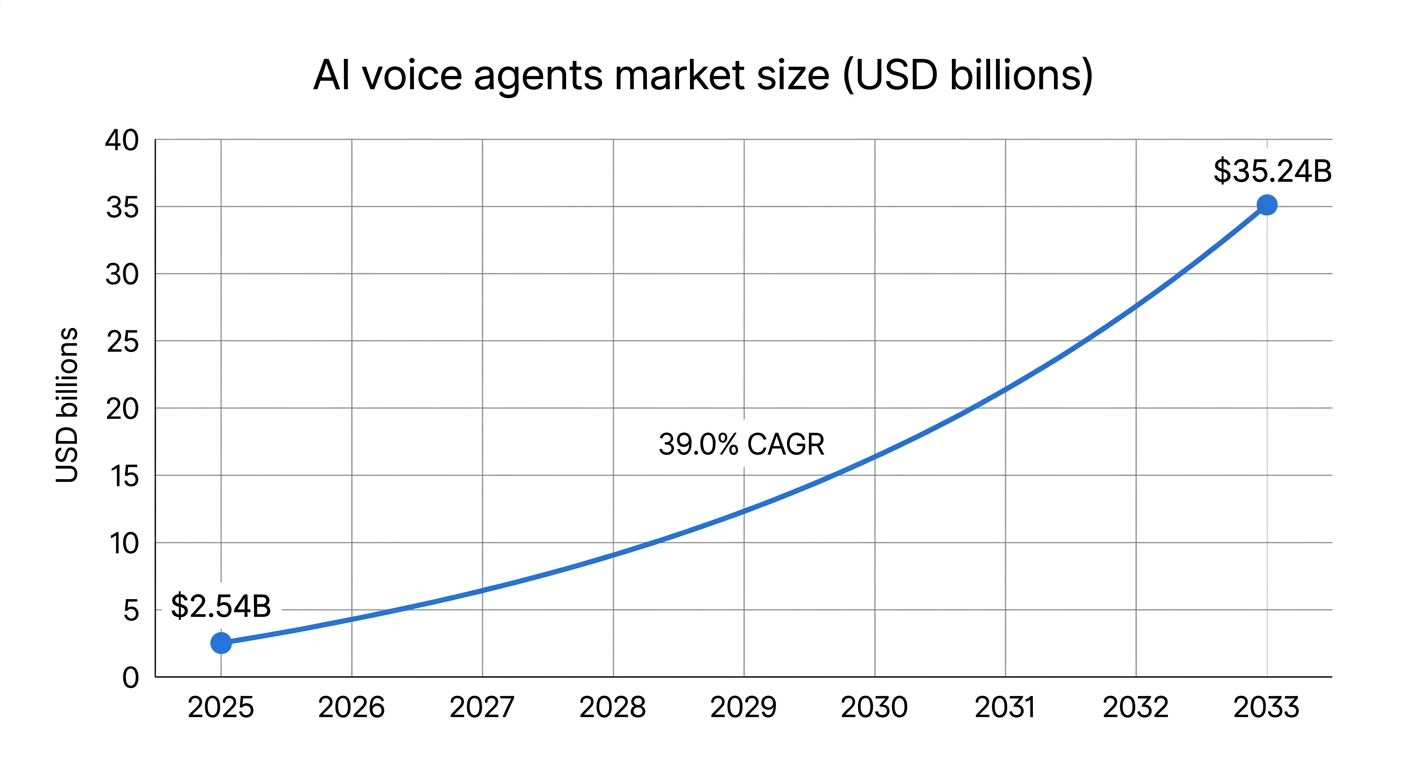
The AI voice agents market is projected to grow from $2.54B (2025) to $35.24B (2033) at a 39.0% CAGR. Source: Grand View Research.
What changes between day one and month 12
The launch demo is the least important number you will see. Resolution climbs only through tuning against your own call mix and the edge cases nobody scripted. The team that ships prompt changes in hours improves faster than the team that files a ticket and waits a sprint.
Scope also widens in ways no one specified at signature. A support agent that started with returns grows into scheduling, financing questions, and delivery updates as callers ask for more. The architecture you pick has to absorb that without a rebuild.
Model costs keep falling, and the team that owns its data and keys captures that gain instead of watching a vendor pocket it. Choose the architecture for month 12.
Two operating habits separate the teams that improve from the teams that stall. The first is a weekly review of failed and escalated calls, read by both the CX owner and an engineer. The second is a regression check before every prompt or model change, so a fix for one intent doesn't quietly break another.
Vapi is built as a single source of truth for building, deploying, adapting, and scaling. Business and engineering iterate on the same agent instead of trading tickets.
How to get started with a CX voice agent
Start narrow. Pick one bounded, high-volume use case where resolution is measurable, like order status or appointment changes. A tight scope gives you a clean baseline to improve against.
Write the agent's job down in plain language before you build. List the intents it must resolve, the systems it must reach, and the moments it should hand off to a person. That short brief becomes your test script and your first success metric.
You can stand up your first agent in minutes in the Vapi dashboard, then tune it without writing code. With Vapi, you describe your use case in Composer, connect it to your telephony, and have it live in minutes.
Pilot against real calls before you scale. Measure resolution and escalation quality from day one so the numbers guide every change.
Frequently asked questions
What is the difference between an AI voice agent and an IVR? An IVR routes callers down a fixed menu tree and stalls when someone goes off-script. An AI voice agent listens, adapts, and responds in natural language, so the caller skips the menu and states the problem directly.
Can AI voice agents replace human agents? Not entirely. They resolve routine, high-volume work and escalate the rest with full context attached, while humans stay in the loop for judgment calls, sensitive situations, and anything the agent can't solve.
What resolution rate should I expect from an AI voice agent? Measure your own baseline first, because it depends on your call mix and systems. SQM Group finds each 1% FCR gain tracks a 1% satisfaction gain; industry-average FCR is near 70%, and world-class is 80% or higher.
How is an AI voice agent for CX different from a chatbot? Voice is a real-time problem, and a live caller reads a pause as a dropped call. That lower tolerance for latency and imperfection raises the bar for turn-taking, interruption handling, and audio quality.
How long does it take to deploy an AI voice agent? A first agent can be live in minutes to days through a sign-up and low-code dashboard. The real value comes from tuning over the following weeks, as you improve resolution against your own call mix.
How do AI voice agents integrate with my CRM and phone system? They connect through tool calling and native integrations, so the agent can look up an order or update a record mid-call. Agents overlay your existing telephony and warm-transfer to human staff with context.