An outbound voice agent hears a human voice whether it reaches a person or a mailbox. A recorded "Hi, you've reached John, please leave a message" and a live "Hello?" sound almost identical because it is the same person's voice.
Voicemail detection is the job of telling those two apart. It has to happen in the first few seconds, before your agent starts talking. Get it wrong, and the agent talks over a greeting or hangs up on a customer.
This post explains how voicemail detection works. You will see which signals agents read and why timing matters more than audio quality. It also covers the synchronous versus asynchronous tradeoff and how to judge accuracy.
If you run outbound calls, this is the decision sitting underneath every one of them. See Vapi's outbound calling docs for the surrounding call flow.
The enterprises coming to us for appointment reminders, collections, lead qualification, and candidate outreach don't just want outbound that works. They want outbound they can run their business on. Voicemail detection is one part of that; Campaigns is the feature we built to automate the actual calling portion.
A recording and a live pickup are both a human voice at similar pitch and energy, so the raw audio spectrum alone will not separate them. A 2026 preprint found that a recorded greeting and a live "Hello?" are spectrally similar, since they are the same person's voice, and that calls also arrive as narrowband 8 kHz audio, run through variable codecs, and carry background noise (arXiv:2604.09675).
Timing is the real constraint. The agent has to classify the answer within roughly three to five seconds of connection, before its own audio contaminates the channel, per the same preprint.
That short window sets up two failure modes with very different costs: talking to a recording, or hanging up on a person.
No single cue is fully reliable on its own. Detection stacks several weak signals into one confident decision.
Live humans say a short greeting and then stop, waiting for a reply. Recordings play straight through at a steadier cadence. This gap, sometimes called call progress analysis, is a core signal that sophisticated AMD relies on (Regal).
Ringing time is a coarse prior too. Very short or very long ring times rarely mean a live human, per Regal.
A human "Hello?" is short. A mailbox greeting runs longer and more continuously, so systems compare duration and rhythm.
Once there is a transcript, the words help. Phrases like "please leave a message after the beep" flag a machine, and "hi, this is" flags a person. Matching works in both directions.
Some systems mark the end of a greeting with a beep, which is a strong confirming signal. It is not universal, and some mailboxes never beep.
Adding beep- or keyword-based features did not improve the best real-time classifier and increased latency, while timing features alone stayed a strong signal in the same preprint.
Some detectors extract spectral features like MFCCs and log-mel spectrograms, then classify with a model, but spectral features alone are limited because voicemail and a live answer are the same human voice, the preprint notes. Others turn audio into Mel spectrogram images and use machine learning image analysis to label them as human or machine, per Regal.
Language models add strong text-level judgment once speech exists. They cannot hear pure silence or a beep, so they get paired with signal-based methods, per Regal.
Vapi's own detection is a hybrid of model-based classification and optional beep detection, covered in the Vapi section below.
These two get conflated constantly. Voice activity detection (VAD) answers a narrow question: is this audio frame speech or not speech (FutureAGI)?
Voicemail detection goes further. It combines VAD output with greeting phrases, timing, and call state to classify the answer type. Answer types include live person, greeting, beep, carrier intercept, and silence.
A long pause might be network delay, a cautious human, or a speakerphone, so treating silence as voicemail is a classic mistake.
Endpointing and turn detection are the same real-time timing discipline. Vapi exposes them as first-class speech configuration settings.
Synchronous detection blocks the call until it has a verdict. It is certain, but it creates dead air the caller hears.

The person on the other end has no patience for dead air, which is why most agents start fast and correct course.
Asynchronous detection lets the agent begin while classification runs, then corrects course if voicemail is confirmed.
Dead air costs more on a live call than in a chat window. A caller gives you no grace for a slow first move, so the tolerance for latency is far lower on voice.
The practical answer is usually asynchronous plus graceful recovery. Start fast, then switch behavior the moment the evidence changes.
Vapi runs real-time monitoring with continuous voicemail polling during the early call stages. The agent reacts quickly and switches back to a normal conversation when a human picks up unexpectedly.
After a machine verdict, the agent has a few standard moves:
Wait for the beep window, or the first words get cut off.
A human picks up during a greeting, or voicemail gets caught after the agent already started, and it has to switch modes cleanly.
Vapi handles this two ways. Automatic detection can interrupt the agent's first message when voicemail is caught mid-sentence, and it switches back if a human picks up mid-voicemail. The assistant-driven voicemail tool lets the agent leave a configured message or end the call silently.
Accuracy claims need scope. A 2026 preprint reported a lightweight timing-based classifier at 96.1% combined accuracy across 764 recordings (arXiv:2604.09675).
In production over 77,000 calls, the same system held a 0.3% false-positive and 1.3% false-negative rate, at about 46 ms inference. Treat that as one well-engineered system, not a universal benchmark.
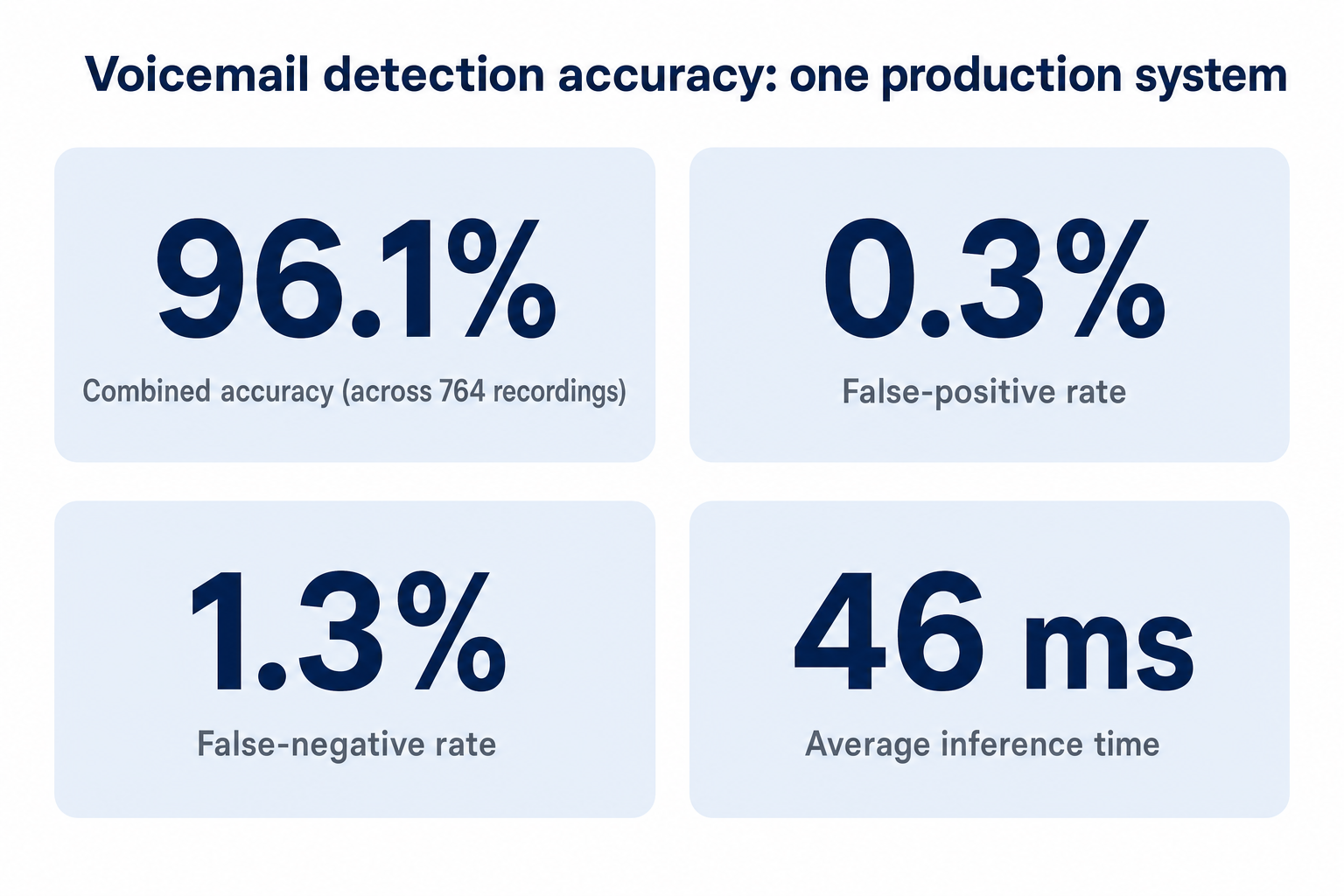
Reported results from one production timing-based classifier. Treat them as directional, not a universal benchmark.
Vendor figures near 95% are common but usually unattributed (Voiso). Use them as directional, not settled.
Measure the two error types separately, because they hurt differently. A false-voicemail marks a real person unreachable and hides a lost conversation, which FutureAGI calls the costlier error for revenue. A false-human wastes minutes and produces junk transcripts.
Track a few things per carrier and locale:
You can validate detection behavior before launch with simulated test calls and watch it afterward with production monitoring.
Carrier and device diversity is the first problem. Mobile voicemail, PBX greetings, and carrier intercepts all sound different, so a detector tuned on one path can fail on another. Test more than one carrier.
Low-quality audio also degrades detection. Narrowband 8 kHz telephony audio strips detail that classifiers rely on, so the same model scores worse on a lower-quality path, the same study found.
Call screening is the newest wrinkle. AI-powered screeners insert a synthetic layer that some detectors score as a live human, the same preprint reports.
This is why provider choice and tunable timing matter. A model-agnostic platform lets you adjust rather than wait on a single vendor.
Vapi treats voicemail detection as a tunable, provider-agnostic part of the real-time pipeline.
You choose the detection method: Vapi, Google, OpenAI, or Twilio, plus the assistant-driven voicemail tool (voicemail detection docs).
Vapi's own detection combines a few methods:
You control the timing:
Two detection types, audio and transcript, let you match the method to your provider. Detection can also interrupt the agent's first message when voicemail is caught mid-sentence and switch back to conversation on a human pickup.
You can also let the agent decide. The voicemail tool leaves a configured or personalized message, or ends the call silently, based on your prompt.
Vapi runs this at scale, serving more than a billion calls for customers that include Amazon Ring, Intuit, and New York Life (TechCrunch).
Getting started is easy. Sign-up for the dashboard and Composer builds an agent in minutes, with voicemail detection built-in.
How do AI voice agents tell a live person from voicemail? They read timing and behavior in the first few seconds, like silence after a greeting and greeting length. Then they classify the answer type before speaking.
How is voicemail detection different from voice activity detection? VAD only flags speech versus non-speech. Voicemail detection adds phrases, timing, and call state to label the answer type.
How fast does detection happen? Usually within a few seconds of the call connecting, because the agent has to decide before it starts talking.
Is beep detection required? No. It helps on systems that beep, but a 2026 arXiv preprint shows timing signals alone can match beep-based approaches.
What should the agent do at voicemail? Hang up, leave a message after the beep, or keep talking when a human picks up. Choose based on whether a missed message is acceptable for your use case.
How accurate is voicemail detection? Well-built systems report the mid-90s in percent, but accuracy depends on carrier, codec, and configuration. Measure your own false-human and false-voicemail rates.
The reliable answer to "person or machine" comes from timing and behavior, decided fast and acted on cleanly. The audio spectrum alone will not get you there.
The teams that win outbound do not chase a single accuracy number. They pick a detection approach they can tune and measure per carrier and use case.
If you are building outbound agents, start with one bounded use case, choose a detection provider, and tune the timing against your own call mix.