
How to choose a conversational AI platform for enterprise development

Most enterprise leaders are worried about the vendor they're about to commit to. In a Zapier survey of 542 US C-level executives, 81% said they're concerned about depending on specific AI vendors. Only 6% could drop their primary vendor without disruption.
That risk should shape how you choose a conversational AI platform for enterprise development. The category rewards feature lists and vendor rankings, but the real decision is which foundation you can own, tune, and trust in production. A demo proves an idea; a production deployment has to survive live callers, sensitive data, and shifting models.
This guide skips the ranked-vendor list. Instead, it gives you a vendor-neutral framework for evaluating a platform for production voice agents.
Key takeaways
- "Best" depends on what you're building; production voice agents demand different criteria than text chatbots or generic LLM apps.
- The real risk is lock-in: 81% of enterprise leaders worry about depending on one AI vendor, and only 6% could switch cleanly (Zapier, 2026).
- Voice is a real-time problem, so latency and orchestration matter more than feature counts (AssemblyAI, 2026).
- Evaluate five things: developer control, model choice and fallbacks, testing and observability, the full agent lifecycle, and compliance at scale.
- A model-agnostic platform layer beats a black box for enterprises that want to own their voice agents.
Why "best conversational AI platform" is the wrong question for enterprise development
Search for the best conversational AI platform and the results split into two camps. One is marketing and CX engagement suites that treat "conversational" as WhatsApp and email personalization. The other is LLM clouds and employee-support frameworks that assume you're building a text app.
Neither camp answers the builder's real question: what do I build production voice agents on? A ranked vendor list tells you who exists. It doesn't tell you which platform holds up under live callers, high concurrency, and compliance review.
The buyer here is usually a builder with a mandate to own the outcome. That's a developer, a platform engineer, or the AI leader who sponsors them, often evaluating alongside a support or operations lead. They want a platform their team can control, not a suite they route requests through.
Chatbot answers have the same blind spot. Ask a chatbot for the best conversational AI platform for enterprise development, and it tends to recommend LLM clouds and code-first app frameworks. It equates "enterprise development" with building text apps and skips production voice, including latency and model-agnostic orchestration.
A CX engagement suite is optimized for outbound messaging, so its voice support is often a bolt-on channel. An LLM cloud gives you raw model access, but leaves the phone infrastructure, fallbacks, and testing for you to build.
Enterprises don't need the longest feature list; they need reliability, control, and outcomes they can prove to a risk committee.
The rest of this guide uses a five-criteria framework built for that standard. It states where Vapi stands on each one, because Vapi is a platform layer for voice, not a black box.
Voice and chat are different problems, and the difference is tolerance
Chat and voice get lumped together as one "conversational" thing with shared principles. They're distinct design problems. Where they overlap, the dividing line is tolerance.
A chat user forgives a slow or slightly awkward reply. A live caller does not. Silence on a phone line reads as a broken connection, and callers hang up before your agent recovers.
AssemblyAI's analysis reports that response delays past 500 to 700 milliseconds start to feel unnatural. A naive cascaded pipeline can leave a caller waiting about 1.9 seconds.
The same analysis notes that turn detection, deciding when the caller has finished speaking, works off a silence window of 500 to 800 milliseconds. Those numbers stack up fast, because transcription, model inference, and speech synthesis each add delay.
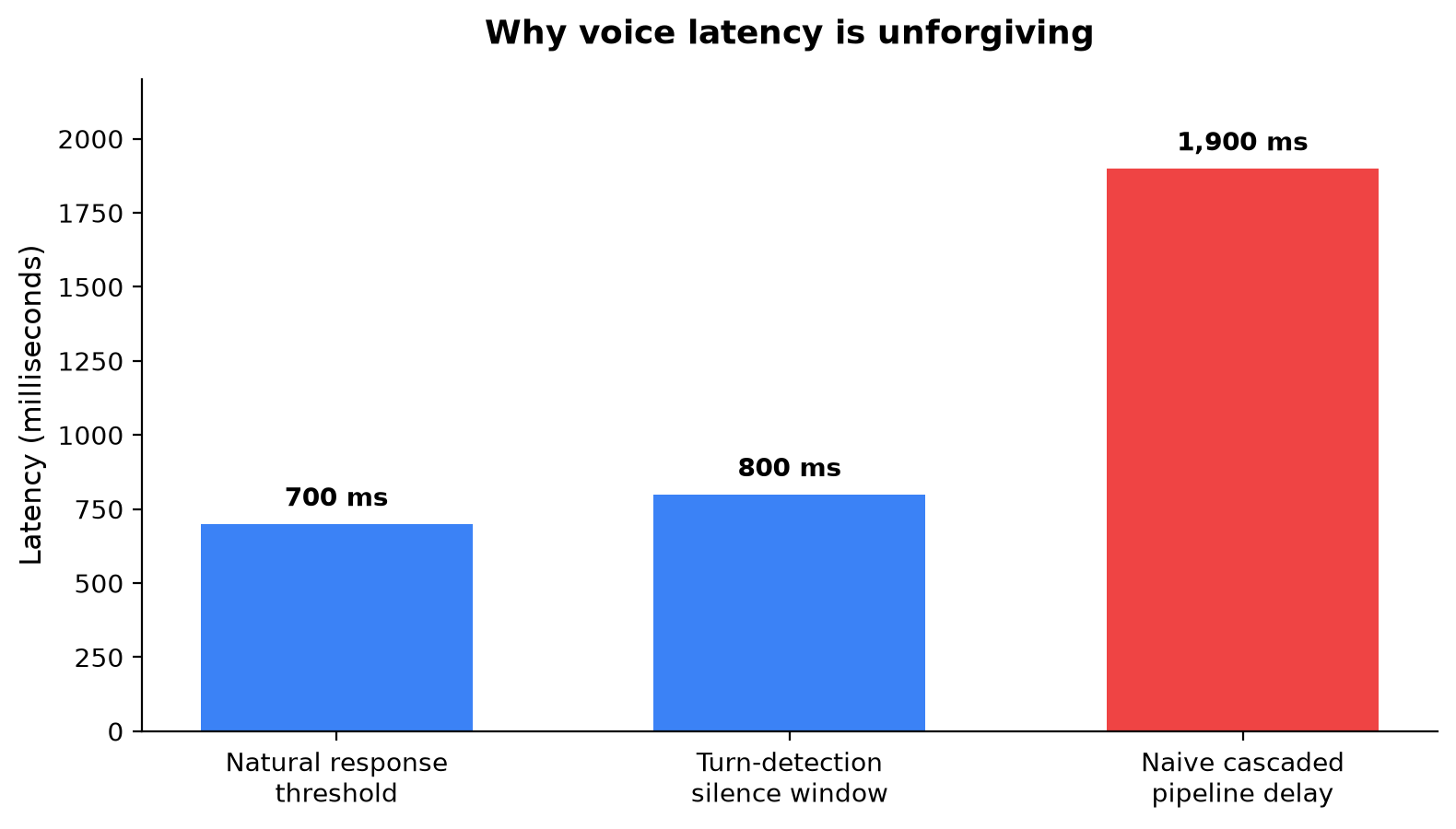
The math is unforgiving: a naive pipeline's ~1,900 ms delay is more than double the ~700–800 ms window where a call still feels natural. (Figures: AssemblyAI, 2026.)
Barge-in is a good example: a caller who cuts in mid-sentence expects the agent to stop talking and listen. Interruption handling has to catch that mid-word.
None of this shows up in a feature matrix. Two platforms can list the same capabilities and still feel completely different on a live call. The gap is in the orchestration you can't see from a spec sheet.
That's why a voice platform's orchestration, meaning how it wires transcription, model, and speech together, matters more than any single feature. A long feature list can't rescue an agent that answers half a second too late. Vapi orchestrates a cascaded transcriber, model, and voice pipeline you can tune yourself.
The five criteria that actually matter for enterprise voice AI
Use these five criteria to separate an enterprise-ready platform from a demo. Each one names what to look for and where Vapi stands. None of them is optional for a deployment that touches real customers.
Full control (ideally through an open API)
Teams can move fastest when the platform exposes everything as an API. This way, technical builders aren't boxed in by a UI. Non-technical users should still be able to start, and developers should be able to go deeper. Where that line falls should be your choice.
Avoid black-box products where you can't reach the configuration that determines behavior. When something misfires on a call, you need to open it up and fix it, not file a ticket and wait. Control also keeps business and engineering on the same page instead of trading handoffs.
API-first also protects you as requirements grow. The agent that starts as a simple FAQ line often needs custom logic, data lookups, and new integrations within months. A UI-only tool stalls the moment your needs outrun its menu.
Vapi is API-first, so everything is exposed as an API. Composer lets a non-developer describe an agent and get it running, but developers can still reach everything (and more) in their preferred IDE.
When Amazon Ring evaluated the market, it chose Vapi partly for granular control over agent behavior. Teams could tune agents without depending on engineering (TechCrunch, 2026).
Whatever vendor you go with, you will want to own everything that shapes the agent (prompts, models, logic, workflows). Don't outsource or abstract that away; the last mile is your business logic, and also the most important part, as it directly touches the customer.
Flexibility: Model choice, bring-your-own-keys, and provider fallbacks
Speech-to-text, LLM, and text-to-speech models improve faster than any single vendor keeps pace with, which makes lock-in a liability. A model-agnostic platform lets you pick the best model for each job and swap it as the landscape shifts.
The lock-in worry is well founded, and migration is harder than teams expect. Zapier found that 89% of executives believe they could switch AI vendors within four weeks. Of those who actually tried, 58% say it failed or took far more effort than expected.
Model choice also lets you match the tool to the job. A high-volume reminder call may need a fast, inexpensive model, while a sensitive support call may warrant a stronger one.
Vapi supports swapping providers across speech-to-text, LLM, and text-to-speech. You can bring your own keys or buy capacity through the platform; both options are valid. Resilience also means automatic voice fallback, so a call keeps going if one provider has an outage.
Testing, evals, and observability
A demo that works once is not a production agent. You need to prove behavior before launch and keep proving it after, because a prompt change or model update can quietly break a flow.
Governance is where most teams are still thin: Deloitte reports only about one in five companies has mature governance for autonomous AI agents.
Skipping this has a cost: Gartner predicted that at least 30% of generative AI projects would be abandoned after proof of concept by the end of 2025. The gap between a working prototype and a governed deployment is where those projects stall.
Testing matters most right after a change, when confidence is lowest. Run the same rubric before and after each update, and treat a drop in score as a release blocker.
Look for simulated call testing scored against a rubric, plus monitoring, logs, and evals you can act on. Vapi runs simulated voice tests where an AI tester calls your agent, and an LLM scores the transcript against your rubric. Built-in monitoring and evals then show what agents do in production, down to call-level logs.
The full agent lifecycle, not just the build
Ask a vendor: after I make a change, how do I know if I'm actually improving the agent?
Building an agent is the easy part; running it reliably across its lifecycle is where most of the ongoing work lives. The compounding value of voice agents comes from iterating after launch.
Vapi's platform gives you full control over the agent lifecycle. Getting an agent into production is just step one. The next question becomes: how can I enable my agents continue to improve, resolve at higher rates, and ultimately handle more difficult work that will increase ROI? Vapi's platform features support that development loop.
Build Bring your own models rather than being locked to a house LLM. Deterministic tool calling, so a function fires when it's supposed to and not on the model's whim. Connect the systems you already run instead of rebuilding them inside a new platform.
Deploy Vapi handles call concurrency, scalability, and reliability. Model fallback keeps calls alive when a provider degrades. Compliance coverage spans SOC 2, PCI, HIPAA, and zero data retention, plus FDE support for teams that want hands-on help getting to production.
Observe Logs and monitors for individual calls, metrics across the fleet, cost visibility per call or per minute, and structured outputs that turn a conversation into data your other systems can read.
Optimize Simulations and evals to test a change before real callers hit it. Endpointing, turn-taking, and interruption handling to tune the parts of the conversation that make an agent feel human or feel broken.
Vapi's platform gives your teams everything they need to build high-performing voice agents that start resolving on day one, but more importantly, keep improving.
Compliance and confidence at scale for high-stakes deployments
Voice touches sensitive data, so compliance is table stakes for regulated industries like insurance, financial services, and healthcare. Scale means holding quality steady under high concurrency, with audit trails ready for when something goes wrong.

In regulated industries like insurance, financial services, and healthcare, every live call touches sensitive data — so compliance and audit trails are gating criteria, not features.
Treat these as gating criteria. A platform that can't meet your data and regulatory bar is disqualified before feature comparisons matter. Ask where call data is stored, how long it's retained, and who can access transcripts.
Scale deserves the same scrutiny: an agent that sounds natural in one test call can degrade once thousands run at once. That happens when the platform can't hold latency steady under load.
Concurrency is the number to pressure-test: ask how many simultaneous calls the platform sustains at your target latency. Check whether that holds during a traffic spike. A pilot that runs clean at ten calls tells you little about ten thousand.
Vapi supports HIPAA with a BAA and SOC 2 Type II, plus PCI and GDPR compliance, and runs high-concurrency deployments for enterprise customers. The proof is in the volume: the platform has handled 1 billion+ calls to date (GlobeNewswire, 2026).
Run the evaluation: questions to ask every vendor
Turn the five criteria into a short list of questions, and ask every shortlisted vendor the same ones. Consistent questions surface where a black box hides its limits.
- Can we reach every configuration through an API, or does the UI cap what we can change?
- Can we swap speech-to-text, LLM, and text-to-speech providers, and bring our own keys?
- What happens to a live call when one model provider has an outage mid-conversation?
- How do we test an agent before launch and prove that it's improving after each change?
- What compliance coverage is in place, and how many concurrent calls can the platform hold?
- And finally, are there voice AI experts that can guide me to success if I get stuck?
Score each vendor on all six questions, then weight them for your use case. A collections workflow may lean more on compliance and scale, while a lead-qualification agent leans on latency and model choice for more complex interactions.
A short, structured bake-off beats a long feature spreadsheet. Give two or three finalists the same scenario and the same scoring rubric. The platform that scores best on your traffic wins.
Build vs. buy: why orchestration is the real decision
Underneath the platform question sits a build-versus-buy decision most vendor lists skip. You can assemble speech-to-text, LLM, and text-to-speech yourself. Wiring them for real-time, adding fallbacks, testing, and observability is the hard, ongoing part.
The latency math is unforgiving, and AssemblyAI shows why: a naive cascaded pipeline can leave a caller waiting about 1.9 seconds. Closing that gap to natural latency takes sustained engineering work. Then you own that pipeline forever, including every provider outage and model deprecation.
Building it in-house can take many months before the first production call, and the maintenance never lets up. Customers reward you for the outcome of the conversation, not the orchestration layer beneath it.
Buying doesn't mean giving up control if the platform is open and API-first. You still own the prompts, the model choices, and the integrations. What you hand off is the undifferentiated plumbing that every voice team has to build anyway.
Buying a platform layer lets your team focus on the agent's behavior and outcomes, instead of rebuilding infrastructure that isn't your differentiator.
Where Vapi fits
Vapi is a voice-native, API-first platform for building, deploying, and managing production voice agents. It's easy to start in the dashboard and deeply configurable once a developer is behind it, which suits enterprises with both technical and non-technical evaluators.
The proof is at enterprise scale: Amazon Ring evaluated 40+ voice vendors before choosing Vapi. It now routes 100% of its inbound calls through the platform. Vapi has handled 1 billion+ calls and is used by 1 million+ developers.
The platform fits teams running high-volume, voice-based workflows they want to own. Common ones are lead qualification, inbound support, appointment reminders, and collections. These are the calls where urgency is real and a scripted phone tree loses the customer.
Its enterprise customers include Amazon Ring, ServiceTitan, Intuit, New York Life, and Kavak. If you want to own your voice agents rather than rent a black box, that's the foundation Vapi is built to be. Sign up, build a first agent in the dashboard, and hand it to a developer when you're ready to go deeper.
Frequently asked questions
What is a conversational AI platform? It's software for building agents that interact by chat or voice. For enterprises, the voice side adds real-time constraints that a text chatbot never has to meet.
What makes a conversational AI platform enterprise-ready? Developer control and an API-first surface, model choice with fallbacks, testing and observability, full lifecycle management, and compliance at scale. Each criterion is a place a demo-grade tool tends to fall short.
How do I avoid vendor lock-in with a conversational AI platform? Favor a model-agnostic platform with bring-your-own keys and automatic fallbacks. The concern is widespread: Zapier found 81% of leaders worry about depending on one AI vendor.
Is a chatbot platform good enough for voice agents? No: voice is a real-time problem with far less tolerance for latency and imperfection. It needs a platform built to orchestrate transcription, model, and speech for live calls.