Onboarding an AI agent should be as simple as onboarding a new employee. Give it the goal, some instructions, and the knowledge and tools to climb toward it. Let it come to you when it needs approval or help. Then let it get better at the job on its own, from the calls it's already taking.
Building that takes a platform that exposes every stage of the agent lifecycle and makes it configurable, and that's the platform Vapi has built.
Today we're launching Agent Loop in early access, with GA planned for early next year. It's a self-improving harness that sits on top of the whole platform. It builds the agent, scores every call against your goal, finds the ones that missed, drafts a fix, tests it, ships it to a slice of live traffic, and measures whether the number moved. Then with recursive self-improvement, it repeats, improving the agent with each pass. Every layer underneath is a knob it can turn to close the gap: models, architectures, voices, configurations, and tools. The primitives it runs on ship to the dashboard along the way, so they're yours whether or not you use Agent Loop, and the same agent is always available in the dashboard too.
Vapi started developer-first, and we built it by exposing every parameter. The platform is the base: production infrastructure, thousands of models and integrations, and pre-built configs for any voice agent use case. On top sit the primitives to optimize an agent: call analysis and monitoring, simulations, traffic routing, and experiments. Set it up, observe the calls, make a change, test it, deploy it, observe again.
Every piece of the loop is there. Assembling them into something you'd trust in production is the hard part. Nearly every customer we talked to in discovery this year had built their own version: a monitoring dashboard, a simulation harness, a script that reads transcripts and flags what broke. Today our forward-deployed engineers run that loop by hand for customers. The only alternative is a professional services contract that takes control away from you, at a tremendous fee.
CarShield's AI specialists, Jonathan Rooney and Abdalnafie Sibaie, described that patchwork firsthand: "I was doing this myself: launching individual test scenarios, doing the outbound call. This is what I need, but I just didn't have the infrastructure to build my own dashboard."
We took everything our forward-deployed team knows, everything we've learned from over a billion calls, and a platform built to expose every primitive, and broke down exactly what makes a voice agent succeed. Then we built a new agentic harness that puts all of it in your hands and makes it easy to act on.
What you see is simple. You create an agent, tell it the goal, and it gets better on its own. You watch it work, approve what you want, and step in whenever you choose. Describe the job in a plain prompt ("Create a customer support agent without deflection"), and you get a working agent scored against a business goal from its first call.
It runs on its own and improves over time, but nothing about it is a black box. It is built as a harness on top of Vapi. Every step is explainable, and every step is real Vapi functionality you can configure and fine-tune. Here's what happens under the hood.
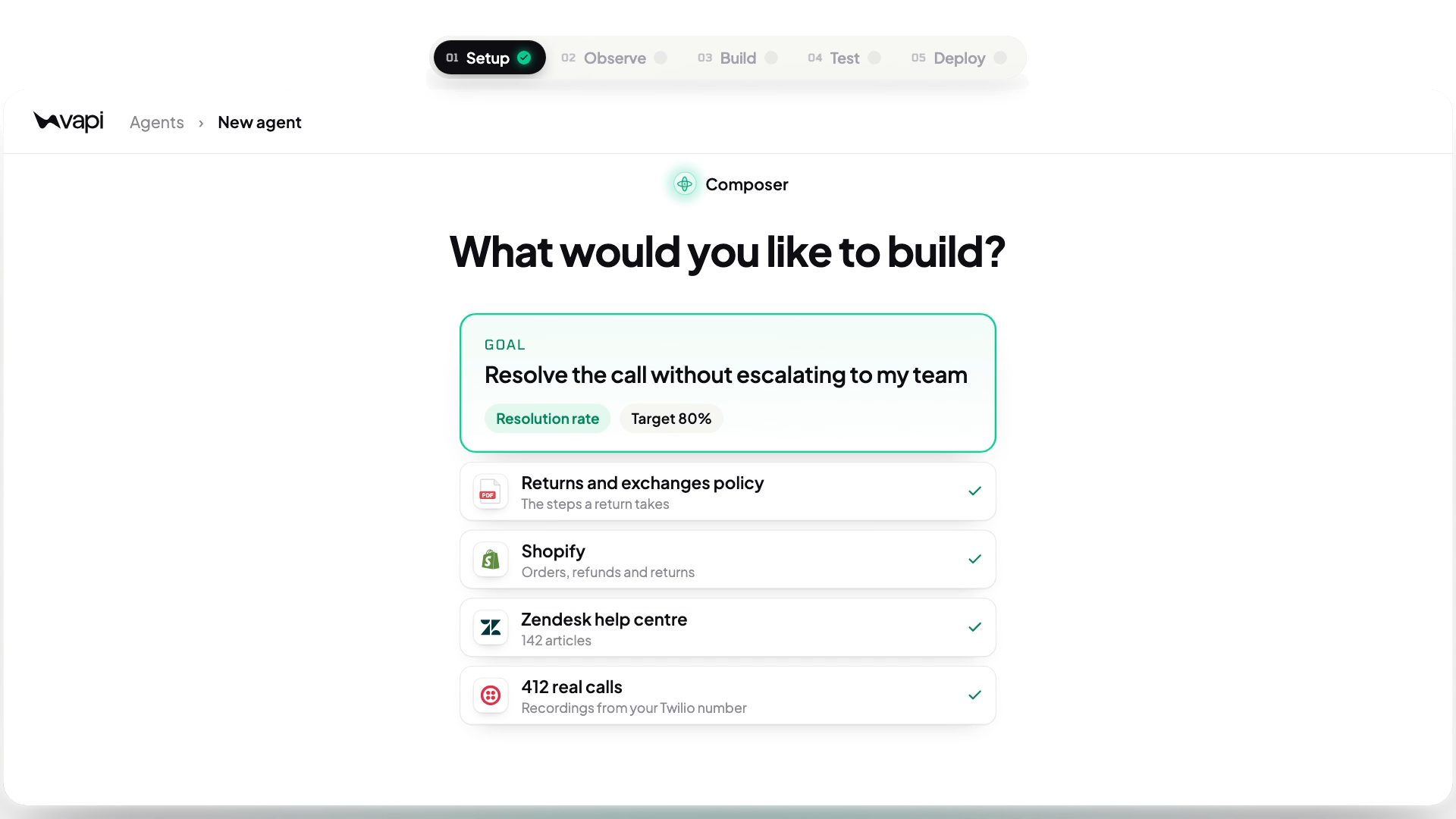
Setup. You start with your goal, say, resolution rate: how many calls are resolved by the agent and not escalated to your team. You give Composer, the AI agent built into the Vapi dashboard, the context it needs: the steps involved, the integrations, your knowledge bases, even real call recordings. Composer, which carries everything our forward-deployed team has learned over thousands of deployments, sets up the tools and prompts, picks the models and architecture, and assembles the first version.
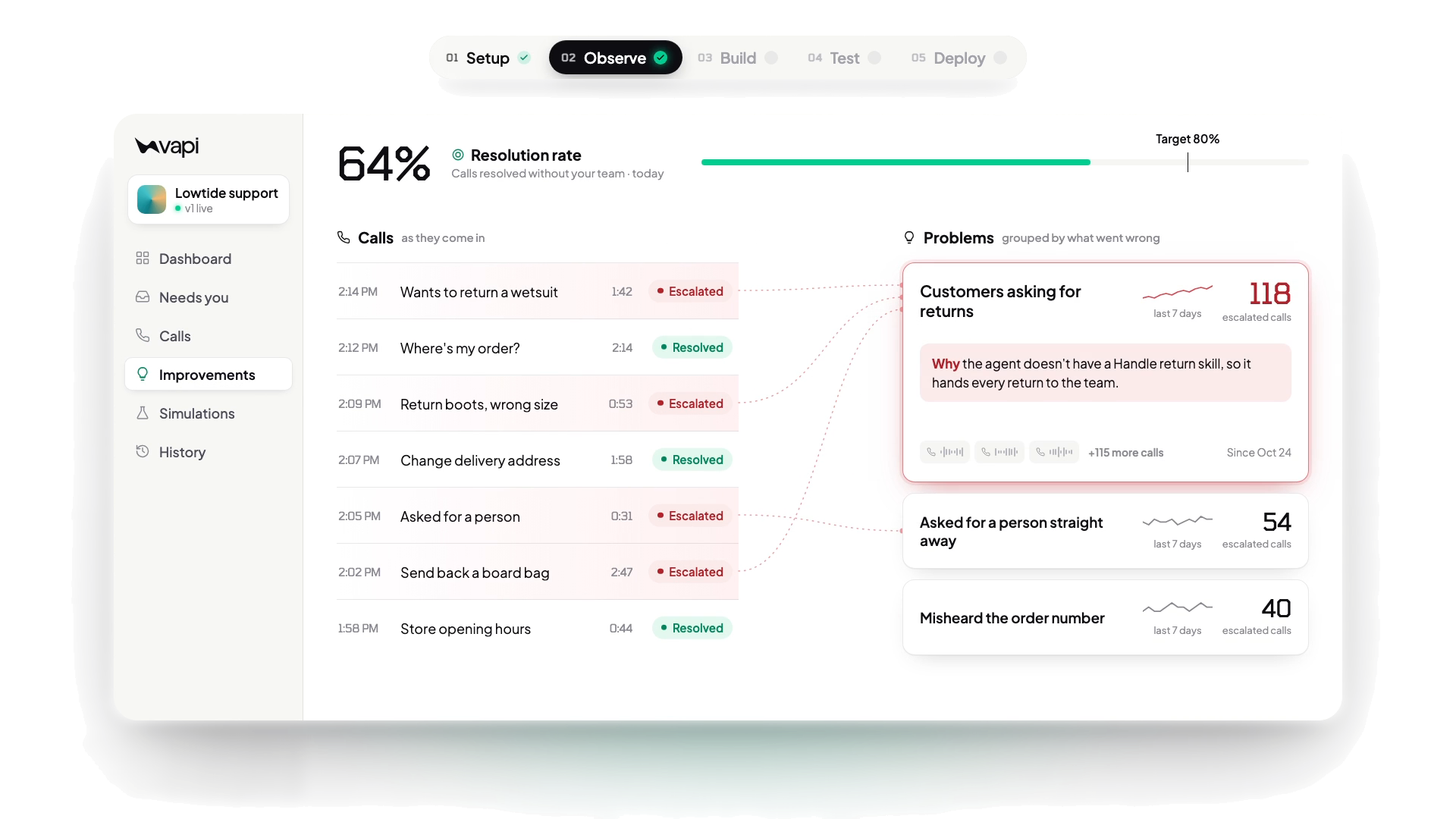
Observe. As calls come in, Agent Loop scores each one against the goal, reviews the misses, and clusters them into issues. Something like "customers are asking for returns, but the agent has no return-handling skill."
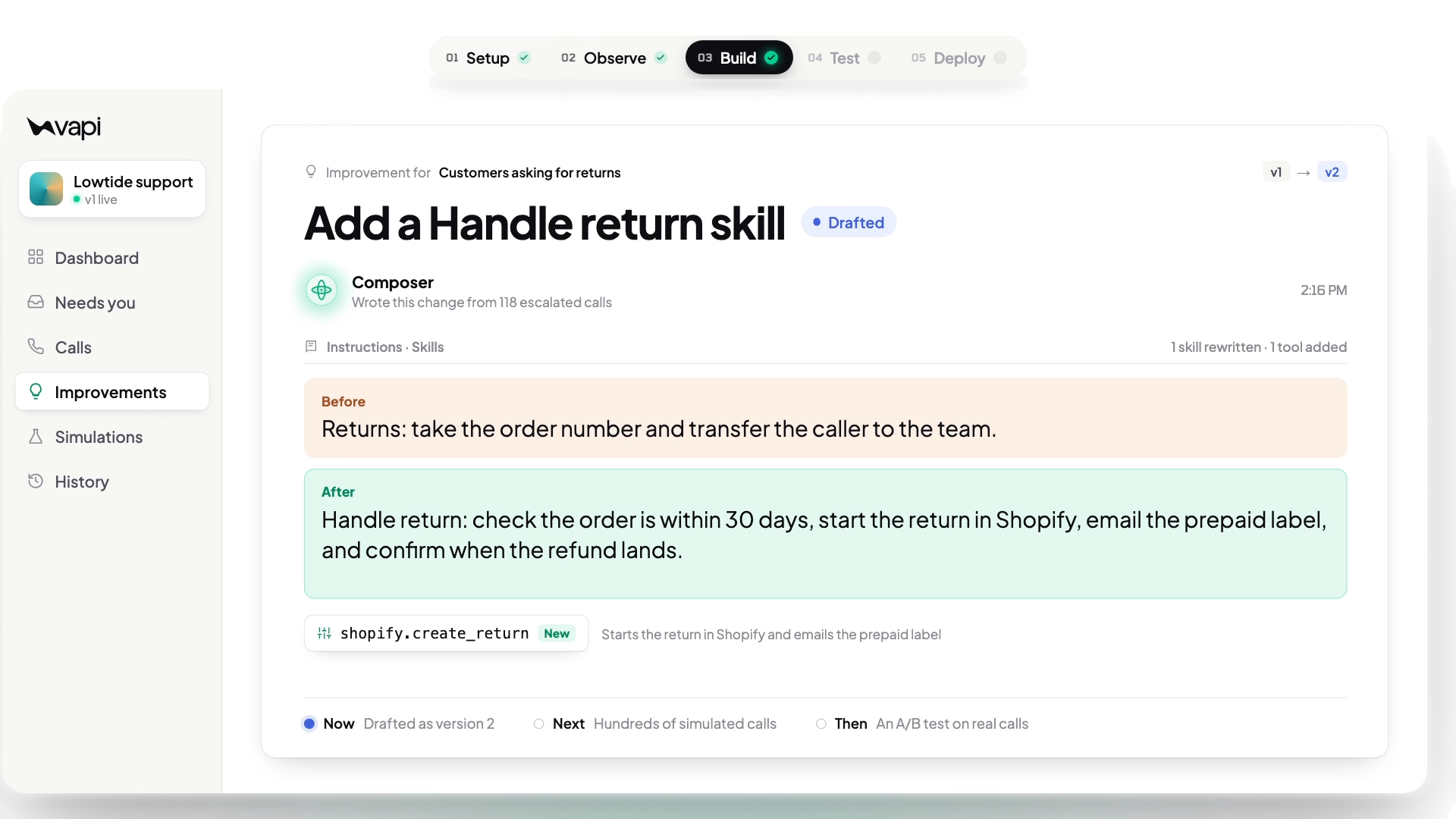
Build. Composer drafts an improvement for the top issue, with the evidence calls and the exact diff, and feeds it back into test.
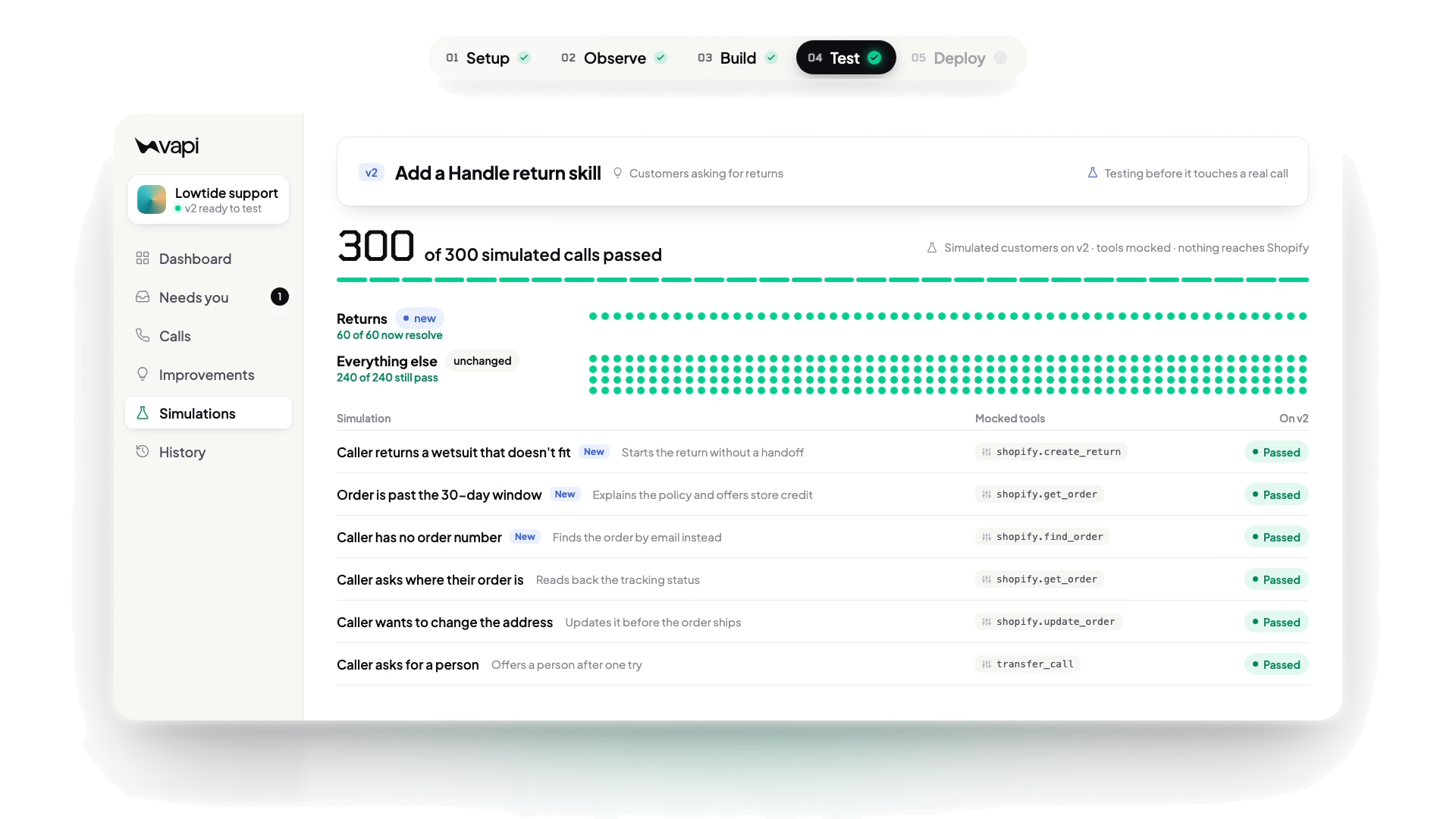
Test. The new version runs through hundreds of simulated conversations to confirm it does what it's supposed to and doesn't break anything else.
Deploy. The change goes out as an experiment on a share of your real traffic, measured against your goal. If it's good, full rollout. If the number drops, it rolls back automatically and records what it learned. It leverages recursive self-improvement: the new version is observed, improved, tested, and deployed again, and the loop repeats until you hit your goal.
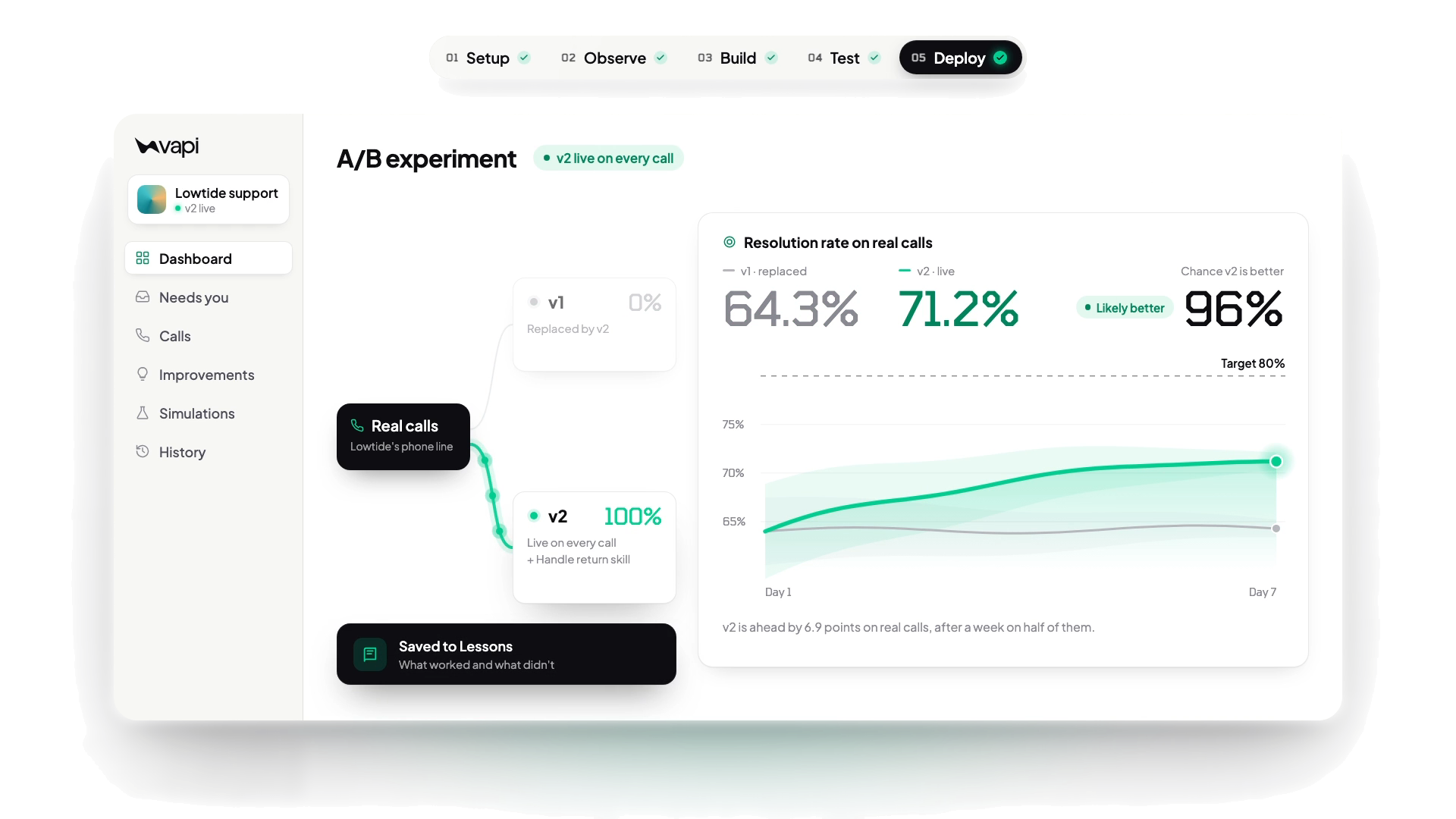
You stay in control the whole way, and nothing ships without a person saying yes. Decisions land in an inbox, which connects to Slack. Over time, as you trust the agent's judgment, you can let it approve more on its own.
"You just did what I was trying to do. This is great if we can push a live event, and then it knows which calls were successful and which weren't, and then it's able to train and improve our agent toward our top outcomes." — Vijeth Vijaykumar, Gen AI Solutions Lead at Descartes
Every Agent Loop agent is a real Vapi assistant underneath. The CX lead who owns the resolution rate runs the agent from Agent Loop and never opens a config. The engineer keeps the full dashboard and API on the same assistant. Lessons record the decisions the business has already made, so a proposed fix doesn't reintroduce the specific decision you made on purpose.
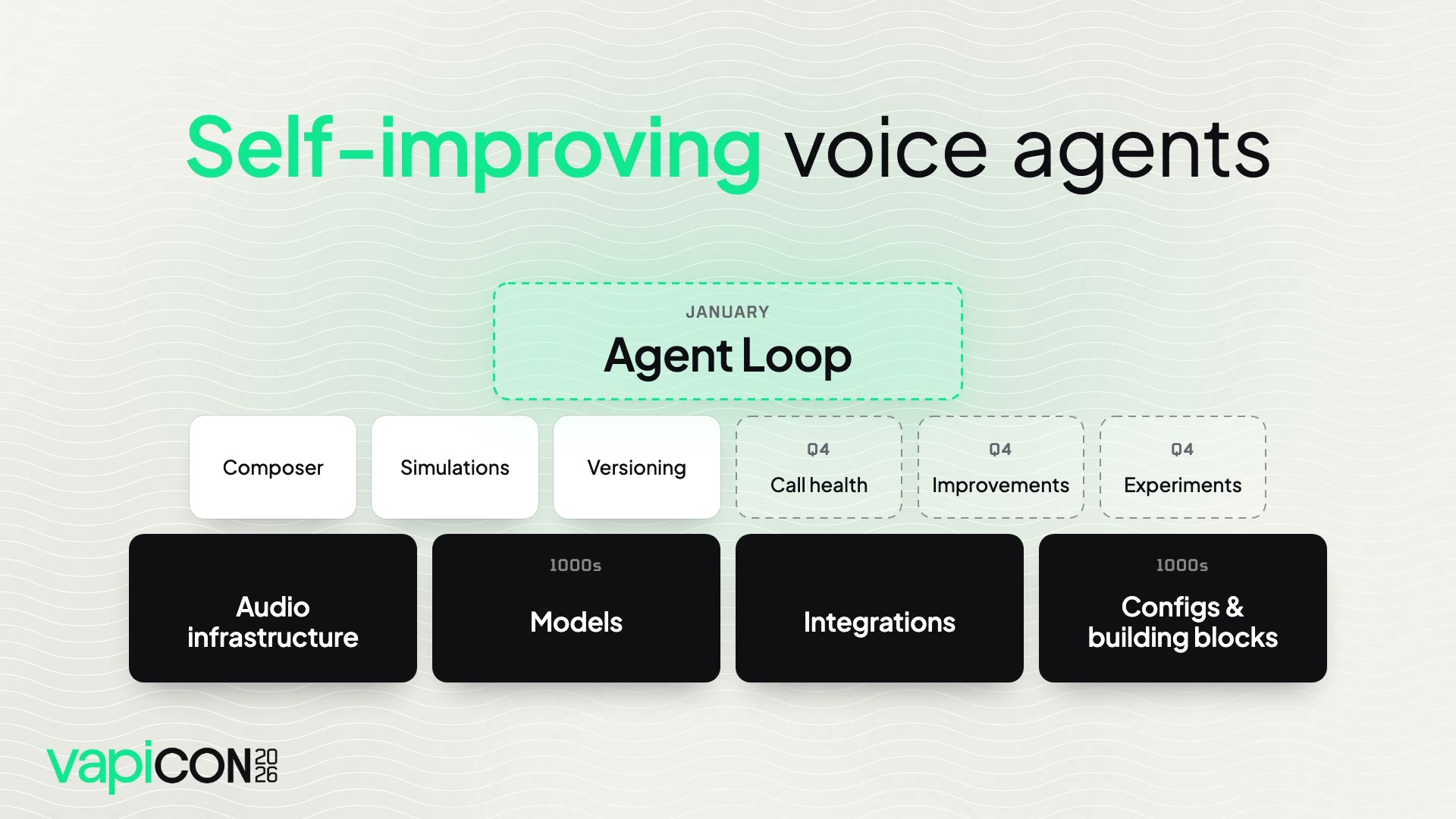
From the outside, Agent Loop is a simple harness that builds, improves, and optimizes an agent for you. Under the hood, it's a set of primitives that work together, each tied to a stage of the loop. All of them are coming to the dashboard too, because they're useful whether an agent is self-improving or you want to fold them into your existing workflows with deeper control.
Together, as part of the agent loop, they run the lifecycle on their own. Goals define success. Call Health finds the misses and proposes the fix. Simulations and Experiments test it. Experiments send it to a share of your callers when you start to see success. You see an agent improving over time. These are the parts doing the work.
Agent Loop is in early access now, with customers already using it and seeing results, and GA is planned for early next year. If you're building on Vapi today, the features will be available in the dashboard over the coming months.
Join the waitlist for Agent Loop early access, and come see it at VapiCon on November 11.