
Vapi AI Outbound Calls vs. Traditional Calls

Introduction
Outbound calls bridge the gap between businesses and customers. As businesses attempt to expand their outreach, manual dialing limits productivity. As per the studies, "52% of outbound marketers say their strategies are ineffective." (Ironpaper). It is difficult to reach a large volume of prospects efficiently.
Well, now imagine creating an AI avatar as per your sales pitch, qualifying leads, gauging interest, and filtering out the noise all while tracking every conversation, even while you’re on a coffee break. In this blog, we’ll explore how businesses can automate repetitive outreach. Further, we’ll break down about outbound calls, practical challenges, and AI-powered solutions available, including VAPI AI outbound calling!
What is an Outbound Call?
Outbound calls refer to calls made by your business’s call center representatives or sales development reps (SDRs) to prospective customers. These calls are aimed at generating leads, closing deals, or nurturing relationships with existing clients. Businesses rely on them to connect with potential customers.
Startups find outbound calls easy, but for enterprises, it's challenging for sales reps due to voicemails and hang-ups, which lower morale. While AI lacks feelings, it efficiently contacts your ideal customer profile (ICP) without fatigue, following scripts and maintaining accuracy. For instance, a car dealer can employ an AI agent to reach potential customers.
There is much to discuss regarding how Sales Reps are becoming outdated for cold outreach and outbound calls. Let’s examine each point of ineffectiveness in detail. If you are one of the sales reps reading this blog, I apologize in advance, but this is a tough pill.
Common SDR Problems: Slow, Expensive, and Inefficient - Don’t Mind Sales Reps
Traditional outbound calling requires businesses to hire, train, and manage a team of Sales Development Representatives (SDRs) or call agents. Scaling up outreach efforts translates directly to increasing headcount, which raises costs without necessarily improving efficiency, creating the below-listed problems:
High Operational Costs
According to a report by Revenue.io, it typically takes 90 days to train a sales rep from onboarding to making their first call or outreach, which usually takes costly resources like requisite training courses and tools required for the sales process, etc. which becomes a burden on the organization’s revenue to train, pay and retain these sales rep.
Wasted Time
If the training is complete and the rep has all the required tools that does not mean that they gonna start getting appointments and conversions from the very first call they made, statistically SDRs waste 60-70% of their time landing in voicemails, getting hung upon and routed to reschedule even the discovery call that they made.
Inconsistent Call Quality
The call quality varies depending on numerous factors such as the agent’s experience, script adherence, and engagement level. With high call volumes, manual follow-ups can be inconsistent, causing potential leads to slip through the cracks.
Feeling quite obsolete yet? If you believe that the above-mentioned problems aren't what you face as an SDR of an organization, then there is something very relevant and very common amongst every sales rep of every sales team of every organization, i.e. SDR BURNOUT. It leads to low productivity, and high turnover rates. Moreover, the performance varies from agent to agent hence, it becomes difficult to measure KPIs.
As businesses struggle with low response rates, missed follow-ups, and overworked sales teams, many are turning to AI voice calling for a scalable solution. AI can automate thousands of calls, maintain consistent messaging, and update your CRM in real time, enabling teams to focus on high-priority leads.
Both established enterprises and startups are increasingly adopting AI outbound calls in their quest to grow. It’s important to streamline your outbound process, as competitors may be closing deals while you’re still hearing, "Your call has been forwarded to voicemail!”
The Shift of Industry Towards AI Voice Calling
According to Gartner, “75% of B2B buyers prefer a rep-free sales experience.” AI outbound calling agents offer speed, scalability, and cost-effectiveness, three essential pillars for any modern sales operation. Unlike human-driven calls, which suffer from high costs and inconsistent results, AI-driven solutions can:
- Increase Efficiency – As per CSO Insights, Inside sales representatives dedicate just one-third of their time to actual selling. At the same time,most the majority of their workday is spent on administrative tasks and lead research. However, AI can make thousands of calls simultaneously. It improves connect rates and reduces idle time drastically.
- Reduce Costs – Businesses can scale their outbound efforts without the need for hiring any additional SDRs or call center executives as such.
- Enhance Lead Qualification – AI analyzes conversations in real time using Natural Language Processing (NLP) to transcribe speech, detect intent, and assess engagement. It identifies high-intent prospects based on keywords, sentiment, and lead-scoring criteria like budget, interest, and urgency. Unqualified leads are filtered out, while qualified ones are automatically logged into CRM systems (e.g., HubSpot, Salesforce) for follow-ups. Consequently, sales reps can focus only on high-value opportunities.
AI outbound calling effectively addresses manual SDR calling issues. Imagine a platform offering various AI tonalities—whether you prefer Jeremy or Jessica or need to cater to customers with a Spanish accent. A platform with adaptable scripts and real-time performance tracking would be invaluable. Vapi AI leads the AI voice market with these features**. At the same time,**, providing diverse agents with essential tonalities and characteristics.
Vapi —The AI Sales Rep
Introduction to VAPI AI
Vapi AI is an advanced AI-driven outbound calling solution that leverages natural language processing (NLP) to conduct human-like conversations. It automates key outbound sales functions, including:
- Cold Calling: Initiates conversations with potential customers using dynamic and personalized scripts.
- Lead Qualification: Filters and prioritizes leads based on predefined criteria.
- Appointment Scheduling: Books meetings and follow-ups with engaged prospects at scale by incorporating dynamic variables and dataset management.
- CRM Integration: Syncs with platforms like HubSpot and Salesforce for facilitating data flow.
 Let's consider a practical use case, say, a customer calls an online store to check if a specific item (e.g. designer handbags) is in stock. Instead of a human agent, the AI system responds and provides the answers to the queries as per the data available in real-time. Also, it suggests similar products in case the particular item is out of stock.
When the customer is ready to purchase, AI guides them through the process by providing various options - buy now, pay later options or a limited-time discount. This AI-powered approach reduces wait times, improves conversion rates, and enhances customer satisfaction.
VAPI AI is for Assistance and Not Replacement
VAPI does not assist your current SDRs; rather, it just eases out the manual processes that require tedious workflows to be followed and tracked. Here's how VAPI automates the complex and laborious workflows
- Qualified Lead Generation: AI-powered voicebots engage potential buyers and sellers with intelligent, natural-sounding conversations. Through dynamic questioning, AI assesses buyer intent, readiness, budget, etc.. Post this, AI filters leads and ensures that only high-intent prospects reach human reps.
- CRM & Workflow Integration: To maximize efficiency, Vapi AI integrates with existing CRM and workflow automation platforms, offering:
- Real-Time Data Logging: Automatically records call summaries, lead scores, and follow-up actions within the CRM.
- Automated Follow-Ups: Schedules follow-up calls, sends appointment reminders, and triggers email/SMS notifications.
- Lead Prioritization: Flags high-value leads for immediate attention, ensuring agents engage with top prospects first.
- Turbo Latency Optimization: Vapi AI ensures your users can experience real-time interactions without delays. The ultra-responsive conversations are facilitated using optimized GPU inference, intelligent caching, and also low-latency audio streaming.
Built on a highly scalable Kubernetes cluster, it supports millions of concurrent calls. The sales remain uninterrupted, even in peak traffic conditions.
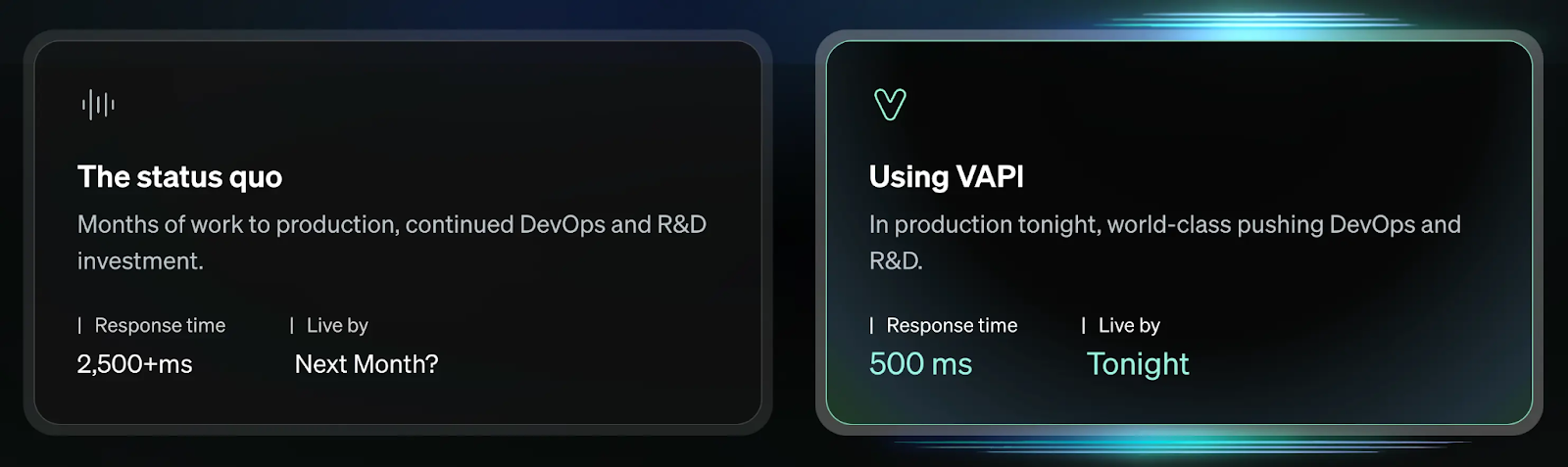 For even greater flexibility, developers can bring their own backend to use function calling to build AI agents that execute complex tasks, from data retrieval to workflow automation. Henceforth, it facilitates an ecosystem with which you can create truly intelligent voice-driven experiences. Also, you can build interactive applications, automate workflows, and enhance customer engagement.
Let’s have a look at the real world use cases to gain a better understanding of Vapi AI, and how it is helping the businesses to scale their outbound operations.
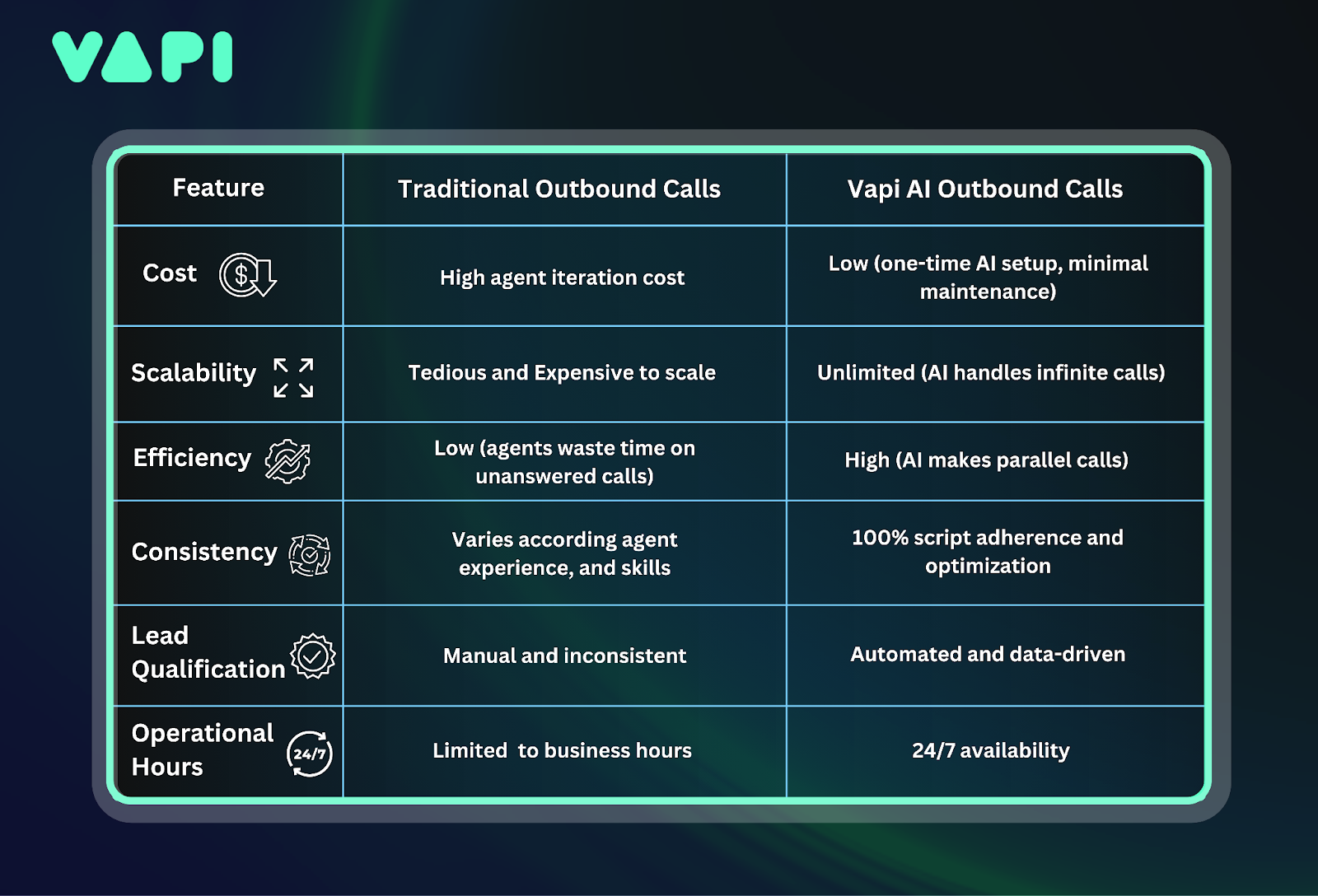
Traditional Cold Calls vs. Vapi AI Cold Calls - Final Showdown
Conclusion
The challenges of traditional outbound calling include high operational costs, wasted time, inconsistent call quality, and missed follow-ups. Today, several AI-powered outbound calling tools are transforming the industry by automating calls, ensuring consistency, and improving efficiency.
Vapi AI is one of such tool platform that goes beyond automation. With multiple AI tonalities, character variations, built-in scripts, and real-time call tracking, Vapi AI helps businesses eliminate the operational bottlenecks of human-driven calling. So scrape of the tedious process your salesforce is managing and automate your outbound processes right away!
FAQs
1. What's the Difference Between Inbound and Outbound Calls?
Inbound calls are initiated by customers contacting a business for support, inquiries, or service. On the other hand, outbound calls are made by businesses to potential customers for sales, lead generation, and follow-ups.
2. Can AI Make Outbound Calls?
Yes, AI tools like Vapi AI can conduct outbound calls through automated voice bots. This allows businesses to manage tasks such as lead engagement, appointment reminders, and surveys without human intervention. Also, it enhances efficiency while lowering costs.
3. What is Vapi Voice AI?
Vapi Voice AI is an advanced voice automation platform that utilizes AI to conduct human-like conversations, automating outbound calls, lead qualification, and customer engagement. Vapi enables the developers to build, test, & deploy voice AI agents in minutes rather than months!
4. Can Vapi AI Integrate With My Existing CRM System?
Yes, Vapi AI integrates with major CRM platforms like HubSpot and Salesforce to log call data and automate workflows.